How to Balance a Redox Chemical Equation in 5 easy steps.


Also watch on Youtube @InoopChem How to balance Redox Chemical Equation in 5 Easy Steps. by Ritik Bhola on Inoopchem YouTube Channel


BALANCING OF CHEMICAL EQUATIONS  OF REDOX REACTION.

According to the law of Conservation of mass each chemical equation must be  arithmetically balanced, that means the number of atoms of each elements on both sides of the chemical equation must be equal.         

Two methods which have been used to balance all types of chemical equations are

1. Oxidation Number method

2. Half equation method Or Ion electron method


1. Oxidation number method.


The various steps are involved in the balancing of redox reactions  by oxidation number method.

Step 1. write the skeletal equation of all the reactants and products of the reaction.

Step 2. Indicate the oxidation number of each element above its symbol and identify the elements which undergoes a change in the oxidation number.

Step 3. Calculate the increase or decrease in oxidation number per atom and identify the oxidizing or reducing agents.

Step 4. Multiply the formulae of oxidizing agent and the reducing agents by suitable Integers so as to equalize the total increase or decrease in the oxidation number as Calculated in step3.

Step 5. Balance all atoms other than oxygen and Hydrogen

Step 6. Finally balance Hydrogen and Oxygen atoms by adding H2O molecules using hit and trial method.

Step 7. In case of ionic reactions.

a) For Acidic medium ,

First balance Oxygen atoms by adding H2O molecules to  whatever sides deficient in Oxygen atoms and then balance Hydrogen atoms by adding H+ ions to whatever side deficient Hydrogen atoms.

b)For Basic medium

First balance Oxygen atoms by adding H2O molecules to whatever side Deficient in Oxygen atoms. The Hydrogen atoms are then balanced by adding H2O molecules equal in number To the deficiency of Hydrogen atoms and an equal number of OH ions are added to the opposite side of the equation, remove the duplication if any.


For Example,


when magnesium is react with nitric acid it gives magnesium nitrate along with Nitrous oxide and water molecule, the reaction is shown below

Mg + HNO3 Mg(NO3)2 + N2O + H2O

Step 1. Indicate the oxidation number of each element above its symbol and identify the Elements which undergoes a change in the oxidation number.

Oxidation number of magnesium is Increases from 0 to 2 in magnesium nitrate.

Mg   +  HNO3   Mg(NO3)2 + N2O  + H2O

Oxidation number of Nitrogen  decreases from +5 to +1 in nitrous oxide

Step2. Calculate the increase or decrease in oxidation number per atom and identify the oxidizing or reducing agents.

Oxidation number of magnesium is Increases from 0 to 2 in magnesium nitrate.

Oxidation number of Nitrogen  decreases from +5 to +1 in nitrous oxide

Therefore Magnesium  will act as Reducing agent and whereas

NITROGEN will act as Oxidizing agent.

Step3. Multiply the formulae of oxidizing agent and the reducing agents by suitable Integers so as to equalize the total increase or decrease in the oxidation number as Calculated in step2.

Mg   +  HNO3 Mg(NO3)2 + N2O  + H2O

Total Increase in OXIDATION NUMBER of Magnesium is +2

Total decrease in OXIDATION NUMBER of NITROGEN per atom Is 2 into 4 = 8

Balance increase or decrease in OXIDATION NUMBER.

On Right Hand Side  there are 2 Nitrogen atoms and Only 1 in Left Hand Side, for equalization multiply HNO3 On Left Hand Side  By 2.

Total increase in OXIDATION NUMBER of Magnesium  is +2

Total decrease in OXIDATION NUMBER of Nitrogen per atom is 2 into 4 = 8,  multiply  Magnesium  on Left Hand Side by 4 we get,

4Mg   + 2HNO3   Mg(NO3)2 + N2O  + H2O

Step4. Balance all atoms other than Oxygen and Hydrogen

To balance Magnesium  on either side, multiply Magnesium nitrate by 4, we get

4Mg + 2HNO3  4Mg(NO3)2 + N2O  + H2O

Now, there are 10 nitrogen atoms on Right Hand Side  in above equation and only 2 in Left Hand Side . For equalization of Nitrogen multiply 2HNO3 by 5, we get, the following reaction.

4Mg + 10HNO3   4Mg(NO3)2 + N2O  + H2O

Step5. Finally balance Hydrogen and Oxygen atoms by adding H2O molecules using hit and trial method. We get,the following equation.

4Mg + 10HNO3 4Mg(NO3)2 + N2O + H2O

There, are 30 oxygen atoms on left Hand Side and on Right Hand Side  there are only 26 oxygen atoms. Therefore to balance Oxygen atoms, Change the coefficient of H2O by 5 we get the Final Balanced equation,

4Mg + 10HNO3 4Mg(NO3)2 + N2O  + 5H2O


1.9 ENTROPY CHANGE IN A IRREVERSIBLE PROCESS – B.SC 2ND YEAR.

Let us now suppose that the same system undergoes the same change in an irreversible manner at a constant temperature T. Entropy being a state function , the increase in entropy of the system will be the same irrespective of the fact whether the change has occurred reversibly or irreversibly.

Thus, ΔS will remain the same as before and represented by the expression,

ΔSsystem = qrev/T …(i)

However, actual amount of heat absorbed by the system from the surroundings will be less, being equal to qirr

It also follows from here that heat lost by the surroundings will be less than qrev.However, in view of the infinitely large size of the surroundings, the lost heat by the surroundings is supposed to take place reversibly , i.e. , infinitelyslowly . therefore, mathematically the entropy change of the surroundings is given by the expression,

ΔSsurroundings = – qirr/T …(ii)

The total entropy change for the combined system and the surroundings ,is,therefore,given by ,

ΔSsystem + ΔS surroundings = qrev/T – qirr/T

Now, since work done in reversible process is maximum , therefore, we can say that

wrev > wirr(iv)

Also, as internal energy (U) is a state function ,therfore, the value of ΔU remains the same whether the process is caried out in a reversible or an irreversible manner.

As such we can say that,

ΔU= qrevwrev = qirrwirr(v)

From equation (iv) and (v) we can say that

qrev > qirr

or,

qrev/ T > qirr/T

or,

qrev/T – qirr/T > 0 …(vi)

where ‘T‘ is the temperature at which the change takes place.

From equation (iii) and (vi), we can say that,

ΔSsystem + ΔSsurroundings > 0

i.e , Entropy change for the combined system and the surroundings in an irreversible process is greater than zero , In other words , an irreversible process is accompained by a net increase of entropy.

It may, therefore be concluded from above discussion that entropy of the system and its surroundings taken together increase in a thermodynamically irreversiblr process at constant temperature but remains unchanged in a thermodynamically reversible process

Thus, for a thermodynamically reversible process

ΔSsystem + ΔSsurroundings = 0 and,

for an thermodynamically irreversible process

ΔSsystem + ΔSsurroundings > 0

on combining both the results , we can say that

ΔSsystem + ΔSsurroundings ≥  0

where sign ‘equal to‘ refers to a reversible process while the sign ‘greater than‘ refers to an irreversible process

The above generalizations can also be used to distinguish between a thermodynamic reversible and an irreversible process.

Second law of Thermodynamics in term of entropy change – Entropy of the Universe : since all process in nature are occurring spontaneously and are thermodynamically irreversible, it follows, therefore. that entropy of the universe is continously increasuing . This is yet another statement of Second law of Thermodynamics.

Clausius summed up the essentials of first law and second law of thermodynamics as :

The energy of the universe remains constant but entropy of the universe is continously increasing and tends towards a maximum.

1.8 ENTROPY CHANGE IN REVERSIBLE PROCESS – B.SC 2nd year.

Let a system undergoes a change of state reversibly at a constant temperature T. The heat absorbed by the system from the suuroundings may be represented by qrev . The increase in entropy of the system (ΔSsystem) will then be given by

ΔSsystem = qrev/T …(i)

Since the surroundings have lost heat equal to qrev , reversibly at the same temperature T , the entropy change of surroundings ΔSsurroundings will given by

ΔSsurroundings = – qrev/T …(ii)

(since the surroundings have lost heat , therefore ,it is given a negative sign)

Therefore , total change in entropy of the system and its surroundings during reversible process is given by

ΔSsystem + ΔSsurroundings= qrev/T – qrev/T = 0

It may, therefore , be concluded that in a reversible process, the net entropy change of the system and the surroundings is zero .In other words , there is no net entropy change in a reversible process.

1.7 PHYSICAL SIGNIFICANCE OF ENTROPY- ENTROPY AS A MEASURE OF DISORD- B.SC 2ND YEAR

The physical significance of entropy can be well understood by an examinatiion of various processes which take place with an increase of entropy. On studying these processes, it has been founded that those processes which are accompained by anet increase of entropy also show an incresed randomness.

Consider, for example, the melting of a solid which is accompained by a net increase of entropy . In this case , at the same time there is an increase in th erandom ness of the atoms, ions or molecules .This is because, in the solids, the ions, atoms or molecules are supposed to have fixed positions and in the molten state, they become more free to move.

The evaporation of aliquid alsoi involves in entropoy as well as disorder

Similarly all spontaneous process like flow of heat from a hot end to a cold end of a conductor , transference of molecules of a solute from a more concentrated to a less concentrated solution, flow of electricity from a poin tat a higher potential to a point at a lower potential are all accompained by a net increased of entropy as well as an increase of randomness or disorder.it

follows from above examples that an increase in the entropy is also accompained by an increase in the disorder of the system.

Therefore entropoy is regarded as a measure of the disorder of the system.

Analogy from daily life The concept of entropy and randomness can be better understood by considering the following exmples in our daily life.

Consider the working of a college, when the different classes are being held in different rooms . The randomness or disorder is minimum. But when the bells goes, the students change their own classrooms and get mixed up for 2 – 3 minutes. For these 2 3 minutes, the randomness (or disorder) and hence, the entropy of the college increases .After 2 or 3 minutes, when the students again occupying different rooms, the randomness (or disorder ) and hence, the entropy of the college again increases

(ii) Before the start of any match between the two teams th edisorder is m,inimum as both the teams are on their respective sides but as the game starts players start running and get mixed up in such a situation , the randomness and hence, the entropy increases.


1.6 CONCEPTS OF ENTROPY – B.SC 2nd year

As, we have studied in section 1.3 that in case of reversible Carnot cycle working between temperature T2 and T1,

q₂-q₁/q₂ = T₂ – T₁ / T₂   or 1 – q₁/q₂ = 1 – T₁/T₂

q₁/T₁ = q₂/T₂ …(i)

where q₂ is the amount of heat absorbed isothermally and reversibly at temperature T₂ and q₁ is the amount of heat lost isothermally and reversibly at temperature T₁,

The equation(i) in its general form may b erepresented as ;

qrev/T = constant

where qrev is the quantity of heat absorbed or evolvedin aprocess carrried out reversibly at a temperature T.

The quantity qrev / T, as we shall aee represents a definite or a state function, viz., the entroopy change of the system.

If heat absorbed (q₂) is given a ppositiv esign an dheat lost(q₁) i sa given a negative sign , equation (i) becomes

+ q₂/T₂ = – q₁/T₁ or q₁/T₁+ q₂/T₂ = 0

Σ q / T = 0 …(ii)

Thereffore, when isothermal and adiabatic processes in a carnot cycle are carried out reveribly (i.e, infinitesimally slowly), the summation of q/T terms is equal to zero.

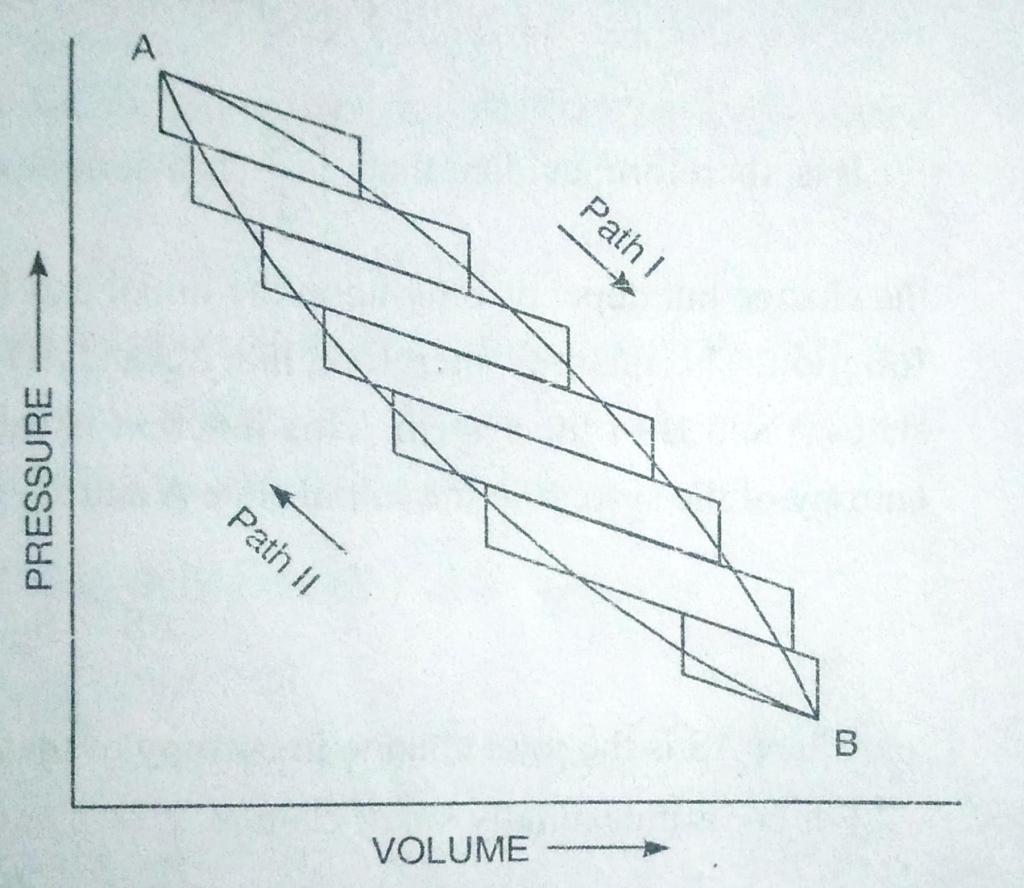
Any reversible cyclic process can be shown to be made up of a series of carnot cycle .let us considered a reversible cyclic process ABA in which the change from A to B and back to stae A ( Fig. 1.3) i scarried out reversibly. Fig 1.3 shows the cycle ABA to be made up of a number of carnot cycles, i.e, of a series of isothermal and adiabatics . The lines slanting horizontally represents adiabatics while those lines slanting vertically represents  isothermals of small carnot cycles . If each Carnot cycle is made extremely small by increasing their number, it can be  made to correspond more closely to continous curve ABA. In such case ,any reversible cycle can be supposed to made up of an infinite number of carnot cycles.

But for each cycle,

q₁/T₁ + q₂/T₂ = 0 …(iii)

Fig.1.3 : Entropy Change in a reversible cyclic process.

Therefore , for the reversible cycle ABA which consist of series of carnot cycles, the above expression can be expressed as,

Σ dq/T = 0

In case,m the changes are infinitesimally small, thenth eabov eequation can be expressede as

Σ dq/T = 0

Since the given cycle is performrd in two steps , viz.,from A to B and back from B bto A, therefore,

  Σ dq/T = AB dq/T  + BA dq/T = 0 . …(iv)

where BA dq/T represents the summation of all the dq/ T terms when the change occurs from A to B via path I and AB dq/T represents the summation of all dq/T terms when the system returns from B to original state A via path II

Evidently from the equation (iv) we have

AB dq/T (path I ) = – BA dq/T (path II)

AB dq/T (path I) = AB dq/T (path II)

It is , therefore, evident that AB dq/T is a definite quantity which does not depend upon the path followed for the change but depends only upon the initial and final states A and B of the system and, is , therefore,  astate function. This quantity, therefore like ΔU and ΔH represemts the change in some singled – valued function of the states A and B of the system. This function is called entropy and is denoted by the symbol S. if SA is the entropy of the system in the initial state A and Sb is the entropy of the system in the final state B, then

ΔS = SB – SA = AB dq/T

where ΔS is the total change in entropy of the system in going from initial state A to the final state B.

for an infinitesimally small change

dS = dq/T

But at  a constant temperature, for a finite change ΔS and Δq can be replaced by ΔS and q respectively . As such, for a finite change at a constant temperrature.

ΔS = q/T

It is important to mention here that since entropy is a function of state only and is independent of path followed, therefore, the change in entropy  in going from initial A to the final state B will invariably be the same whether the change is brought about reversibly or not. but, mathematically, it will be expressed by the expression.

ΔS = AB dq/T

only when the change has been brought about reversibly. this is because the above equation has been derieved from carnot cycle in which all the changes are brought about in a reversible manner.

It is not easy to define the actual entropy of the system. However, it is more convenient to define change of entropy of a system.

The change in entropy of a system may be defined as the integral of all the terms involving heat absorbed (q) divided by the absolute temperature (T) during each infinitesimally small change of the process carried out reversibly.

Thus, for a change at constant temperature,

ΔS = qrev/T

Thus, in simple words, the entropy change may also be defined as the quantity of heat absorbed isothermally and reversibly divided by the absolute temperature (T) at which heat is absorbed.

UNITS OF ENTROPY.

Change in entropy (ΔS) is expressed as

ΔS = qrev/T

Therefore, units of entropy should be expressed as calories per degree i.e., Cal deg-1. This is also called entropy unit.

SI UNITS.

SI units of entropy, accordingly, should be joules per degree kelvin (JK-1)

Since entropy is an extensive property, its value should  depends upon the quantity of the substance involved. Generally, its expressed for one mole of the substance. Hence depending upon the unit of heat, the unit of entropy are either expressed as calories per degree per mole or joules per kelvin per mole.


Rating: 1 out of 5.

Tell us how we are doing by star rating above.

Go back

Your message has been sent

Warning
Warning
Please rate our website(required)

Warning
Warning
Warning!

“I strongly believe that the power of food has a fundamental place in people’s homes that binds us to the best things of life.”

— Lakin Smith

1.5 THERMODYNAMIC SCALE OF TEMPERATURE

BEFORE PRECEEDING…, MOTIVATION IS NECESSARY

IF IT DON’T CHALLENGE YOU, IT DON’T CHANGE YOU
  • As we know the scale of an thermometer is depends on the physical properties like “Thermal expansion” of the liquid used in the thermometer.
  • Since,  different liquids have different cofficient value of expansion, and also do not expand uniformly over a given range of temperature, therefore thermometers are constructed by using different liquids will show different numerical values on thermometer
  • THE TEMPERATURE AT WHICH AN IDEAL GAS CEASES TO EXSIST IS TAKEN AS ZERO DEGREE ABSOLUTE (-273.15ᵒC)  AND THE SCALE DEVELOPED BY TAKING ZERO DEGREE ABSOLUTE AS THE ZERO  IS KNOWN AS THE IDEAL GAS TEMPERATURE SCALE AND IS INDEPENDENT OF THE IDEAL GAS TAKEN.

LORD KELVIN, developed a scale of temperature based upon the SECOND LAW OF THERMODYNAMICS

  • Based on his temperature scale and efficiency of the reversible heat engine, He named his temperature scale THERMODYNAMIC SCALE OF TEMPERATURE Or KELVIN SCALE OF TEMPERATURE. it is very similar to the ideal gas temperature scale.
  • All the reversible engines are operating between tempratures T₁ and T₂ having the similar efficiency i.e. , η = f ( T₁ – T₂ )
  • where f is a universal function independent of the working fluid.
  • since,
    • η = q₂q₁/q₂ = 1 – q₁/q₂ = 1 + q₂/q₁,
  • therefore, q₂/q₁ must also be a function of temperatures of the two reservoirs. A number of different temperature scale that satisfy this relation can be deviesed ; but by taking temperature as directly proportional to the ideal gas temperature scale.
  • If q₂ is the heat transfer from the source (heat resevior at higher temperature) and q₁ is the heat transfer to the sink (reservoir at lower temperature) and θ₁ and θ₂ are their temperatures on kelvin scale, then
    • q₂/q₁ = θ₁/θ₂
  • in other words , we have defineed the ratio of two temperatures in a way is independent of nature of the thermometric substance.
  • Taking the reciprocal of equation 1 , we have
    • q₁/q₂ = θ₁/θ₂ or 1- q₁/q₂ = 1- θ₁/θ₂
    • q₂q₁/q₂ = θ₂-θ₁/θ₂
  • Now, if θ1 = 0 (which corresponds to zero of nwe scale), then
    • q₂-q₁/q₂= θ₂/θ₂= 1
  • In other words, this means that zero on the kelvin scale is the temperature of the sink for a reversible engine whose efficiency is unity but according to equatiion (15) section 1.3,
    • Efficiency(η) = q₂-q₁/q₂ = T₂ – T₁/T₂
  • it is possible only at absolute zero on the ideal gas scale of temperature. from this, it can be concluded that kelvin scale and gas scale are identical; provided the gas is supposed to be ideal, The temperature on the thermodynamic scale is , therefore expressed in kelvin (K).

Learning fact

The only two non-silvery metals are gold and copper. …

INDEPENDENT SLAVE.

Tap here

First of all, on this auspicious occasion of independence, on behalf of InoOP Chem, I congratulate all the revolutionaries, our brave soldiers, their sacrifices for the country. And I congratulate all my countrymen on Independence Day.

As we all Indians know that why we celebrate Independence Day on 15th August with great joy and enthusiasm.

Perfect because we all Indians got our freedom on this day.We got independence on 15th August 1947, today we are celebrating 75th year of our independence.Have we really got freedom even after 75 years of independence?  Are we all still free?You all must be thinking that yes we are free Now just ask yourself are we really free?Let me tell you yes we are free and we live in a free country where everyone is free.  May I ask you once again that everyone is free?

No, we are still slaves of our

1. MENTALITY.

  Don’t you think  We are the ones who differentiate between boy and girl because of our small mentality.

We have been stopping the girls from studying, from flaring ahead, isn’t it slavery?  Our evil eye towards girls, misbehaving with them for not getting dowryOur thinking is the proof of our slavery

The future of the country is both a boy and a girl, we have to change our thinking, our big thinking will give us freedom from this small thinking.We will not change this thinking forever, only then boys and girls will make the future of the country by deceiving them.

2 .CORRUPTION

We are still slaves of corruption, after independence from the British, we have been slave to this.Corruption is like a termite.  Like wood, it will make the whole country weak and hollow.Before this, we have to end it in time to make the country weak and hollow on the termite of corruption.Only then will we be able to imagine a prosperous and free India.

3. POVERTY

As the age of a small child increases, in the same way poverty is also increasing in our country.

Even after 75 years of independence, we could not get freedom from poverty till today.  Poverty is a dictator who forces his subjects to die for straw by strawTheir life turns from bad to worse, no bread to eat, no roof to stay, only tears, they have only tears.

Many of our brothers and sisters are imprisoned in the slavery of this dictator, as Indians, it is our duty to save our brothers and sisters from the clutches of poverty.

From the end of poverty we can imagine a prosperous and happy India.

4 ILLITRATION

We have never known the importance of writing our studies, if we had known in time, then today we would not have been illiterate and would not have been slaves of this illiteracy.

At all India level, the adult (15+ years) literacy rate is 69.3% and that among males is 78.8% and females is 59.3%. Rural – Urban gap existed in Adult literacy rate for both females and males..

Today’s youth are falling prey to illiteracy due to lack of proper guidance. If the youth of the country is not educated, then the country will grow it today?

If we want to progress our country, then the youth of the country will have to be educated, the rate of illiteracy will have to be reduced.

We have to reduce the rate of illiteracy, only then our country will progress.

5 TECHNOLOGY

Technology has also developed with the booming country.  It is believed that the country which has the most technology is rich in that country. India is also moving ahead in technology, technology is used to advance the country. Technology is used for facilities but slowly we are becoming its slaves, it fills us with laziness.If technology has advantages, then it also has disadvantages, like this mobile phone, it was invented for communication.But today’s youth use it in wrong things, in chatting and making videos.

The youth of the country has lost its purpose in the cycle of this advanced technology. Got caught in the web of technology.
we have to take some concrete steps soon. Otherwise our country will lag behind despite having enough technology.

As we have discussed above, we are all slaves to something, even after freedom, we should try to remain free by breaking the shackles of every slavery.

HAPPY INDEPENDENCE DAY

JAI HIND, JAI BHARAT

BY RITIK BHOLA
Founder and CEO of InoOP chem.

ASSESSMENT – 1.

FOLLOW – UP PROBLEMS

1. Calculate the amount of heat supplied to carnot cycle working between 368K and 268K, if the maximum work obtained is 890 joules.                                   

2. A carnot engin eworking between 373K and 273K takes up 840 joules from the high temperature reservoir. Calculate the work done , the heat rejected and the efficiency of the heat engine.

3. Calculate th efficiency of a steam engine which operates between 373K and 573K. What is the minimum heat which must be withdrawn from the reservoir to obtain 171.52 joule of work ?

4. Two steam engines , one red and one black , take steams at 277ᵒC, while red engine rejects it at 27ᵒC , the  black one reject it at 47ᵒC. compare the efficiencies of the engines.   

5. Calculate the efficiencies of a carnot engine working between 200K and 1000K.                              

6. Heat supplied to a carnot engine is 453.6 kcal. How much useful work can be done by the engine which work between 0ᵒC and 100ᵒC ? 

7. A carnot engine converts one sixth of heat input into work . When the temperature of the sink is lowered to 335K, its efficiency is doubled. Calculate the temperature of source and the sink.                       

8. If the efficiency of a carnot engine is the same (i) between 100 K and 400 K and (ii) between T K and 800 K, calculate the temperature T of the sink.      

9. Calculate the maximum efficiency of a steam engine operating between 110ᵒC and 250ᵒC. What would be the  efficiency of engine if the boiler temperature is raised to 140ᵒC, the temperature of the sink remaining same?

10. What per cent T₁ and T₂ for a heat engine whose efficiency is 10% ?                 

SOLVED PROBLEMS.

Retain in memory.

  • Efficiency of a reversible carnot engine(η) = w/q₂ = q₂-q₁/q₂=T₂-T₁/T₂
  • where,
  • w= Net work done by the system ( Joules /calories) ;
  • q₂= Heat absorbed by the system (Joules / calories) ;
  • q₁= Heat given to the sink (Joules / calories) ;
  • T₂= Temperature o fthe source (Kelvin) ;
  • T₁ = Temperature of the sink (kelvin) ;

EXAMPLE 1. Calculate the efficiency of a reversible carnot engine working between 100K and 500K. calculate the work obtainable in joules if the engine absorbs 1KJ of heat at the higher temperature.

Solution. Given : T₁ = 100K ; T₂ = 500K

Efficiency (η) = T₂-T₁/T₂

= 500-100/500

= 0.80

= 80%

EXAMPLE 2. Calculate the amount of heat supplied to carnot cycle working between 368K and 288K if the maximum work is obtained is 895 joule.

Solution. Given : T₂ = 368K ; T₁ = 288K ; w = 895 joule

now,                          w/q₂ = T₂-T₁/T₂

895/q₂ = 368 – 288 / 368

= 80/368

q₂ = 895 x 368 / 80

= 4117 joules

EXAMPLE 3. What should be the temperature of the sink for efficiency of carnot’s engine to be unity?

Solution.    Efiiciency of the carnot engine (η).

η = T2-T1/T2

since,                               η = 1

1 = T₂-T₁/T₂ 

or, T₂ – T₁ = T₂

or T₁ = 0K

= – 273ᵒ C

EXAMPLE 4. What percent T1 is of T2 for a heat engine whose efficiency is 50%?

Solution.  As we know that,

η= T₂-T₁/T₂

η = 50% = 0.5  (given)

T₂-T₁/T₂ = 0.5

or,

T₂-T₁ = 0.5 T₂

or,

T₁ is 50% of T₂

EXAMPLE 5. An engine operates between 1000K and 500K but passes the waste heat to the secon dengine which is working between 500K and 200K. What is the total efficiency obtained in this case?

Solution. Efficiency of the first engine.

η₁= 1000 – 500 / 1000

= 0.50

= 50 %

i.e. , 50% of heat is rejected to the second engine.

Efficiency of the second engine.

η₂ = 500 – 200 / 500

= 0.60

= 60%

i.e. , 60% of the rejected heat from first engine i.e. , 60% of 50% i.e. ,30% is converted into work .

∴         Total efficiency = 50% + 30% = 80%

LEARNING FACT

“AROUND 1% OF THE SUN’S MASS IS OXYGEN

1.4 CARNOT THEORM

From the equation of Efficiency of a heat engine

Efficiency (η) = q₂-q₁ / q₂ = T₂-T₁ / T₂

The efficiency of an engine working reversibly depends only on the temperature of the source and the sink and is independent of the nature of the substance or substance used or modes of operation of the engine. This can be put in the form of a statement known as CARNOT THEORM according to which:

The efficiency of a reversible heat engine depends only upon the temperature of the source and the sink and is independent of the nature of the working substance or substances used or mode of operation of the engine.

▪️The same idea may be expressed by stating that all the periodic machines working reversibly between the same temperature of source and sink have the same efficiency.

▪️It is also clear from the above discussion that while all the other form nof energy can be completely converted into heat , the complete conversion of heat into any other form of energy cannot occur witth out leaving some lasting changes some where in the system .

▪️ This help us to enunicate second law of thermodynamics according to which it is not possible to convert heat into work with out  compensation.