How to Balance a Redox Chemical Equation in 5 easy steps.


Also watch on Youtube @InoopChem How to balance Redox Chemical Equation in 5 Easy Steps. by Ritik Bhola on Inoopchem YouTube Channel


BALANCING OF CHEMICAL EQUATIONS  OF REDOX REACTION.

According to the law of Conservation of mass each chemical equation must be  arithmetically balanced, that means the number of atoms of each elements on both sides of the chemical equation must be equal.         

Two methods which have been used to balance all types of chemical equations are

1. Oxidation Number method

2. Half equation method Or Ion electron method


1. Oxidation number method.


The various steps are involved in the balancing of redox reactions  by oxidation number method.

Step 1. write the skeletal equation of all the reactants and products of the reaction.

Step 2. Indicate the oxidation number of each element above its symbol and identify the elements which undergoes a change in the oxidation number.

Step 3. Calculate the increase or decrease in oxidation number per atom and identify the oxidizing or reducing agents.

Step 4. Multiply the formulae of oxidizing agent and the reducing agents by suitable Integers so as to equalize the total increase or decrease in the oxidation number as Calculated in step3.

Step 5. Balance all atoms other than oxygen and Hydrogen

Step 6. Finally balance Hydrogen and Oxygen atoms by adding H2O molecules using hit and trial method.

Step 7. In case of ionic reactions.

a) For Acidic medium ,

First balance Oxygen atoms by adding H2O molecules to  whatever sides deficient in Oxygen atoms and then balance Hydrogen atoms by adding H+ ions to whatever side deficient Hydrogen atoms.

b)For Basic medium

First balance Oxygen atoms by adding H2O molecules to whatever side Deficient in Oxygen atoms. The Hydrogen atoms are then balanced by adding H2O molecules equal in number To the deficiency of Hydrogen atoms and an equal number of OH ions are added to the opposite side of the equation, remove the duplication if any.


For Example,


when magnesium is react with nitric acid it gives magnesium nitrate along with Nitrous oxide and water molecule, the reaction is shown below

Mg + HNO3 Mg(NO3)2 + N2O + H2O

Step 1. Indicate the oxidation number of each element above its symbol and identify the Elements which undergoes a change in the oxidation number.

Oxidation number of magnesium is Increases from 0 to 2 in magnesium nitrate.

Mg   +  HNO3   Mg(NO3)2 + N2O  + H2O

Oxidation number of Nitrogen  decreases from +5 to +1 in nitrous oxide

Step2. Calculate the increase or decrease in oxidation number per atom and identify the oxidizing or reducing agents.

Oxidation number of magnesium is Increases from 0 to 2 in magnesium nitrate.

Oxidation number of Nitrogen  decreases from +5 to +1 in nitrous oxide

Therefore Magnesium  will act as Reducing agent and whereas

NITROGEN will act as Oxidizing agent.

Step3. Multiply the formulae of oxidizing agent and the reducing agents by suitable Integers so as to equalize the total increase or decrease in the oxidation number as Calculated in step2.

Mg   +  HNO3 Mg(NO3)2 + N2O  + H2O

Total Increase in OXIDATION NUMBER of Magnesium is +2

Total decrease in OXIDATION NUMBER of NITROGEN per atom Is 2 into 4 = 8

Balance increase or decrease in OXIDATION NUMBER.

On Right Hand Side  there are 2 Nitrogen atoms and Only 1 in Left Hand Side, for equalization multiply HNO3 On Left Hand Side  By 2.

Total increase in OXIDATION NUMBER of Magnesium  is +2

Total decrease in OXIDATION NUMBER of Nitrogen per atom is 2 into 4 = 8,  multiply  Magnesium  on Left Hand Side by 4 we get,

4Mg   + 2HNO3   Mg(NO3)2 + N2O  + H2O

Step4. Balance all atoms other than Oxygen and Hydrogen

To balance Magnesium  on either side, multiply Magnesium nitrate by 4, we get

4Mg + 2HNO3  4Mg(NO3)2 + N2O  + H2O

Now, there are 10 nitrogen atoms on Right Hand Side  in above equation and only 2 in Left Hand Side . For equalization of Nitrogen multiply 2HNO3 by 5, we get, the following reaction.

4Mg + 10HNO3   4Mg(NO3)2 + N2O  + H2O

Step5. Finally balance Hydrogen and Oxygen atoms by adding H2O molecules using hit and trial method. We get,the following equation.

4Mg + 10HNO3 4Mg(NO3)2 + N2O + H2O

There, are 30 oxygen atoms on left Hand Side and on Right Hand Side  there are only 26 oxygen atoms. Therefore to balance Oxygen atoms, Change the coefficient of H2O by 5 we get the Final Balanced equation,

4Mg + 10HNO3 4Mg(NO3)2 + N2O  + 5H2O


1.2 ELECTRONIC CONFIGURATION AND POSITION IN THE PERIODIC TABLE – B.SC 2ND YEAR

we were complete INTRODUCTION and OCCURRENCE OF LANTHANOIDS in previous blog. now its turn to have a look on ELECTRONIC CONFIGURATION AND POSITION OF LANTHANOIDS IN THE PERIODIC TABLE.

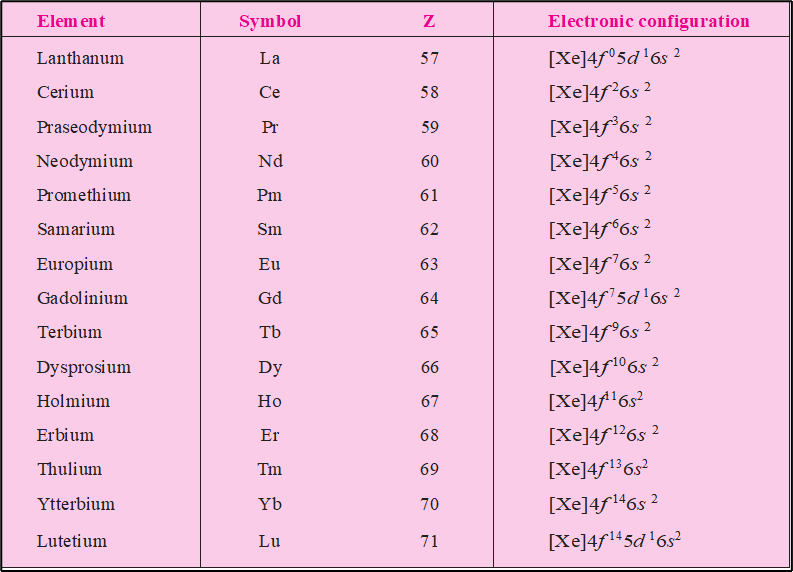
Lanthanoids involve in the gradual filling of 4 f-orbitals. The ground state electronic configuration of each lanthanoid element has two electron in 6 s-orbitals. Sincs the energies of 6s,5d and, 4f are nearly equal, therefore, the order of filling of the 4 f-orbitals in atoms shows some irregularities. At lanthanum (Z=57), both 5d and 4f orbitals become stable due to the increased effective nuclear charge because of poor shielding effect of 6s electrons .It is, therefore, observed that a lanthanum, the comming electron enters the 5 d-orbital and electronic configuration of lanthanum is

La (Z=57) : [Xe]⁵⁴4f ⁰ 5d¹ 6s²

However on moving further after the lanthanum, the energy of 4f-subshell becomes distinctly lower than the 5d-subshell and therefore the next electron in cerium enters 4f-subshell. The electronic configuration of cerium therefore, is represented as

Ce (Z=58) : [Xe]⁵⁴ 4f ² 5d⁰ 6s²

This trend of filling 4f-subshell continues further until we reach ytterbium in which 4f-subshell gets completely filled. thus, ytterbium has the electronic configuration

Yb(Z=70) : [Xe]⁵⁴ 4f¹⁴ 5d⁰ 6s²

Now, after filling 6s– and 4f– orbitals, the next electron does not have a choice and has to go to 5d-orbital. So, in lutetium (Z=71), the next electron enters 5d-orbital and its electronic configuration is

Lu (Z=71) : [Xe]⁵⁴ 4f¹⁴ 5d¹ 6s²

It may be noted here that the electronic configuration of penultimate shell (n=5) is invariably s²p⁶ except for three elements, namely, lanthanum ( Z=57 ), gadolinium ( Z= 64) and lutetium (Z = 71) in which these have one electron in 5d-subshell also. It may also be observed that 4f-orbitals are completely unoccupied in case of lanthanum ( Z = 57) , are half filled in case of europium ( Z= 63), and gadolinium (Z=64) and completely filled in lutetium ( Z = 71).

Table 1.1: Electronic configuration of Lanthanoids

Image reference : flexiprep.

1.1 OCCURANCE OF LANTHANOIDS – B.SC 2ND YEAR

Although these elements are not abundant by any means, but they are considered to be rare in the sense in which this word was used earlier. their sustaintial deposits have been found in several countries particularly in India, Scandinavia, USA, and Russia. The most commonly occuring lanthanoid in cverium which constitutes about 3 x 10 -9 % of earth’s crust.

Main minerals of lanthanoids are :

1. Monazite  : It is most important mineral containing lanthanoids. it is essentially a lanthanoid orthophosphate. some monazite deposits contain appreciable amounts of thorium also. In some cases, thorium may be present to an extent of 30%.

It is interesting to note that elements with even atomic numbers are relatively more abundant and also have a large number of isotopes. whereas The elements with odd atomic numbers are less abundant and do not have more than two isotopes.

Promethium (Pm) (Z = 61) does not occur in nature and has been prepared artificially by radioactive disintegration.

2. Bastnaesite : It is a mixed fluorocarbonated MᴵᴵᴵCO₃F, where M is Lanthanoid (La). Monazitre and Bastnaesite have almost similar distribution of metals ( mainly Ce, La, Nd, and Pr) except that monazite contains approximately 8-10% ThO₂  and 3% ytterium earths which are almost not there in bastnaesite.

Large amount of bastnaesite minerals are found in California, Sweden and New Mexico.

3. Cerite : It contains silicates of  Ce, La, Pr, Nd, and Sm and occurs in Sweden and Norway.

Some other minerals which are found in small amounts are :

1. Crthite : it contains double silicates of cerium.

2. Xenomite : it contains ytterbium and thorium.

3. Euxenite : it contains Ce, Nb, Th, and ytterbium earths.

4. Galolinite : it contains ytterbium earths Ce, Th.

1. INTRODUCTION TO LANTHANOIDS & ACTINOIDS.

The elements in which the last electron enters any one of the seven f-orbitals of their respective ante-penultimate shells are called f-block elements.

In all these elements, the s-orbital of the last shell (n) is completely filled, the d- orbitals of the penultimate (n -1) shell  is invariably contains zero or one electron but the f-orbitals of the ante-penultimate shell (n -2) shell (being lower in energy than d-orbitals of the penultimate shell) gets positively filled in. Hence, general outer shell electronic configuration of  f– block elements is (n 2) f ⁰⁻¹⁴ ns² , where n = 6, 7.

There are two series of f-block elements each containing 14 elements each. Therefore, there are 28 f-block elements in all in the periodic table. These elements are placed at the bottom of the periodic table.

The elements of  the first series (4 f – series), i.e. from lanthanum (₅₇La) to Lutetium (₇₁ Lu), which forms a part of sixth period are collectively called lanthanoids or lanthanides.

Since all the these elements follow lanthanum in the periodic table and closely resemble lanthanam (La) in their properties. Since all these elements occurs scarcely in the earth’s crust, therefore, these are also called rare earth elements. In lanthanoiuds , 4f orbitals are being progressively filled.

The second series (5 f-series) consist of elements from actinium (₈₉Ac) to lawrencium ( ₁₀₃Lr) and forms a part of incomplete seventh periiod. Since these elements follow actinium in the periodic table, therefore, these elements are also called actinoids or actinides.

In actinoids, 5f- orbitals are being progressively filled in and these elements resemble actinium in their properties.

All actinoids are radioactive elements the first four i.e. actinium (Ac), thorium (Th), protactium (Pa) and uranium (U) occur in nature while the remaining eleven elements from neptunium (₉₃Np) to lawrencium (₁₀₃Lr) are prepared artificially through nuclear reactions.

These eleven elements follow uranium in the periodic table and are prepared through nuclear reactions, therefore , these are also called transuranic or transuranium elements.

Lanthanoidd and actinoids which contitute the f block elements are also called inner transition elements because they form transitiion series with in the transition elements of d-block.