Efficiency : The fraction of the total amount of heat absorbed by an engine which it can convert into work is known as efficiency of the engine. thus,
Efficiency of a heat engine (η) = Work done by the engine / total heat absorbed at a upper temperature T₂
η = w / q₂ [ from equation (12)]
= T₂ – T₁/ T₂ Equation………..(14)
Since T₂-T₁/T₂ is invariably less than 1, the efficiency of a heat engine is always less then unity. In other words, no heat engine has yet been constructed whose efficiency is equal to unity. Such a possible is denied by second law of thermodynamics.
It also follows from equation (14) that the efficiency of the heat engine depends upon the magnitude of difference between temperature T₂ and T₁, i.e, greater the difference between the temperature of the source and sink, greater is the efficiency of the heat engine. This also justifies the use of superheated steam in steam engines as compared to simple steam.
According to the first law of thermodynamics,
“Net work done by the system = net amount of heat absorbed by the system.“
Since net work done by the system is w and net vamount of heat absorbed by the system q is equal to q2-q1, therefore,
The above equation has been derived by assuming that various steps in the above cycle were brought about in a thermodynamically reversible manner so as to get maximum work. Since this cannot be achieved in actual practice, therefore, efficiency of the heat engine is even less that given by the above equation.
we were complete INTRODUCTION and OCCURRENCE OF LANTHANOIDS in previous blog. now its turn to have a look on ELECTRONIC CONFIGURATION AND POSITION OF LANTHANOIDS IN THE PERIODIC TABLE.
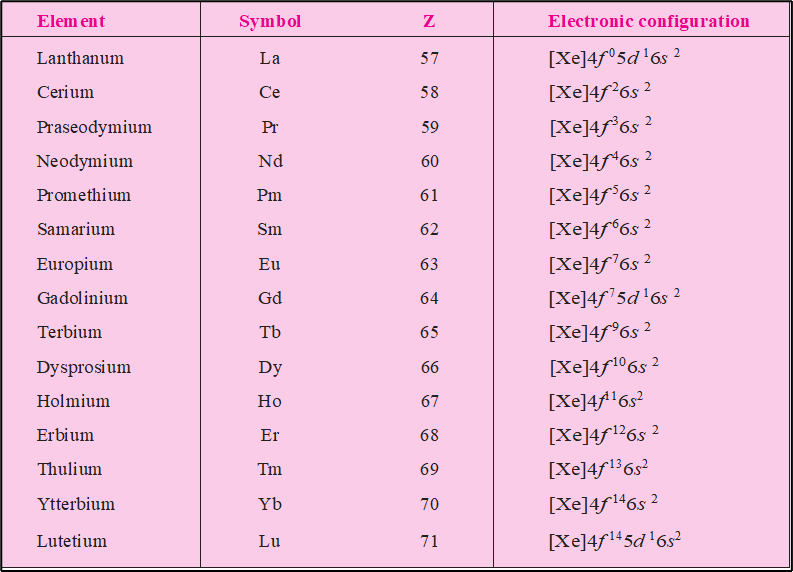
Lanthanoids involve in the gradual filling of 4 f-orbitals. The ground state electronic configuration of each lanthanoid element has two electron in 6 s-orbitals. Sincs the energies of 6s,5d and, 4f are nearly equal, therefore, the order of filling of the 4 f-orbitals in atoms shows some irregularities. At lanthanum (Z=57), both 5d and 4f orbitals become stable due to the increased effective nuclear charge because of poor shielding effect of 6s electrons .It is, therefore, observed that a lanthanum, the comming electron enters the 5 d-orbital and electronic configuration of lanthanum is
La (Z=57) : [Xe]⁵⁴4f ⁰ 5d¹ 6s²
However on moving further after the lanthanum, the energy of 4f-subshell becomes distinctly lower than the 5d-subshell and therefore the next electron in cerium enters 4f-subshell. The electronic configuration of cerium therefore, is represented as
Ce (Z=58) : [Xe]⁵⁴ 4f ² 5d⁰ 6s²
This trend of filling 4f-subshell continues further until we reach ytterbium in which 4f-subshell gets completely filled. thus, ytterbium has the electronic configuration
Yb(Z=70) : [Xe]⁵⁴ 4f¹⁴ 5d⁰ 6s²
Now, after filling 6s– and 4f– orbitals, the next electron does not have a choice and has to go to 5d-orbital. So, in lutetium (Z=71), the next electron enters 5d-orbital and its electronic configuration is
Lu (Z=71) : [Xe]⁵⁴ 4f¹⁴ 5d¹ 6s²
It may be noted here that the electronic configuration of penultimate shell (n=5) is invariably s²p⁶ except for three elements, namely, lanthanum ( Z=57 ), gadolinium ( Z= 64) and lutetium (Z = 71) in which these have one electron in 5d-subshell also. It may also be observed that 4f-orbitals are completely unoccupied in case of lanthanum ( Z = 57) , are half filled in case of europium ( Z= 63), and gadolinium (Z=64) and completely filled in lutetium ( Z = 71).
Table 1.1: Electronic configuration of Lanthanoids
Although these elements are not abundant by any means, but they are considered to be rare in the sense in which this word was used earlier. their sustaintial deposits have been found in several countries particularly in India, Scandinavia, USA, and Russia. The most commonly occuring lanthanoid in cverium which constitutes about 3 x 10 -9 % of earth’s crust.
Main minerals of lanthanoids are :
1. Monazite : It is most important mineral containing lanthanoids. it is essentially a lanthanoid orthophosphate. some monazite deposits contain appreciable amounts of thorium also. In some cases, thorium may be present to an extent of 30%.
It is interesting to note that elements with even atomic numbers are relatively more abundant and also have a large number of isotopes. whereas The elements with odd atomic numbers are less abundant and do not have more than two isotopes.
Promethium (Pm) (Z = 61) does not occur in nature and has been prepared artificially by radioactive disintegration.
2. Bastnaesite : It is a mixed fluorocarbonated MᴵᴵᴵCO₃F, where M is Lanthanoid (La). Monazitre and Bastnaesite have almost similar distribution of metals ( mainly Ce, La, Nd, and Pr) except that monazite contains approximately 8-10% ThO₂ and 3% ytterium earths which are almost not there in bastnaesite.
Large amount of bastnaesite minerals are found in California, Sweden and New Mexico.
3. Cerite : It contains silicates of Ce, La, Pr, Nd, and Sm and occurs in Sweden and Norway.
Some other minerals which are found in small amounts are :
1. Crthite : it contains double silicates of cerium.
2. Xenomite : it contains ytterbium and thorium.
3. Euxenite : it contains Ce, Nb, Th, and ytterbium earths.
4. Galolinite : it contains ytterbium earths Ce, Th.
The elements in which the last electron enters any one of the seven f-orbitals of their respective ante-penultimate shells are called f-block elements.
In all these elements, the s-orbital of the last shell (n) is completely filled, the d- orbitals of the penultimate (n -1) shell is invariably contains zero or one electron but the f-orbitals of the ante-penultimate shell (n -2) shell (being lower in energy than d-orbitals of the penultimate shell) gets positively filled in. Hence, general outer shell electronic configuration of f– block elements is (n –2) f ⁰⁻¹⁴ ns² , where n = 6, 7.
There are two series of f-block elements each containing 14 elements each. Therefore, there are 28 f-block elements in all in the periodic table. These elements are placed at the bottom of the periodic table.
The elements of the first series (4 f – series), i.e. from lanthanum (₅₇La) to Lutetium (₇₁ Lu), which forms a part of sixth period are collectively called lanthanoids or lanthanides.
Since all the these elements follow lanthanum in the periodic table and closely resemble lanthanam (La) in their properties. Since all these elements occurs scarcely in the earth’s crust, therefore, these are also called rare earth elements. In lanthanoiuds , 4f orbitals are being progressively filled.
The second series (5 f-series) consist of elements from actinium (₈₉Ac) to lawrencium ( ₁₀₃Lr) and forms a part of incomplete seventh periiod. Since these elements follow actinium in the periodic table, therefore, these elements are also called actinoids or actinides.
In actinoids, 5f- orbitals are being progressively filled in and these elements resemble actinium in their properties.
All actinoids are radioactive elements the first four i.e. actinium (Ac), thorium (Th), protactium (Pa) and uranium (U) occur in nature while the remaining eleven elements from neptunium (₉₃Np) to lawrencium (₁₀₃Lr) are prepared artificially through nuclear reactions.
These eleven elements follow uranium in the periodic table and are prepared through nuclear reactions, therefore , these are also called transuranic or transuranium elements.
Lanthanoidd and actinoids which contitute the f block elements are also called inner transition elements because they form transitiion series with in the transition elements of d-block.
S.Carnot a french engineer working in french army. In 1824, he observed that the maximum transformation of heat into work can be possible if all the intermidiate steps in the cyclic processses are carried out reversibly. such reversible cycle is called a CARNOT CYCLE. and the engines operating on the basis of carnot cycle called CARNOT ENGINE.
▪️Although the concept of carnot cycle is totally imaginary and theoretical and cannot be achieved in actual practice, but still the concept of carnot cycle is helpful in the calculation of efficiency of the heat engine.
▪️For understanding the concept of Carnot cycle, i’m showing you an expression for the efficiency of a Carnot engine, using a very systematic arrangement.
▪️let us take a cylinder of any material as the working material and an ideal gas, i.e. , for making the analysis easier and simplified. So for the deriving of efficiency of a carnot engine.
▪️Carnot took one mole of an ideal gas as the working substance in a cylinder fitted with a weightless and frictionless piston so that all the process can be carried out reversibly. and, The cylinder is supposed to be insulated from all the sides except from the bottom, which allows the flow of heat to or from the system through the bottom only. The cylinder can be placed on two reservoirs, one at a higher temperature T₂, called SOURCE, and the other at lower temperature T₁, called SINK.
▪️If the process is carried out by placing the cylinder on the source or sink, it can continously exchange the heat with surroundings resulting in the decreasing or increasing the temperature, so that the temperature remains constant. such processes are called ISOTHERMAL – PROCESSES. while ,
▪️If the process is carried out by placing the cylinder on an isulating material, then, no exchnage of heat take place with surroundings, such processes are called ADIABATIC PROCESSES.
STEPS INCLUDING CARNOT CYCLE.
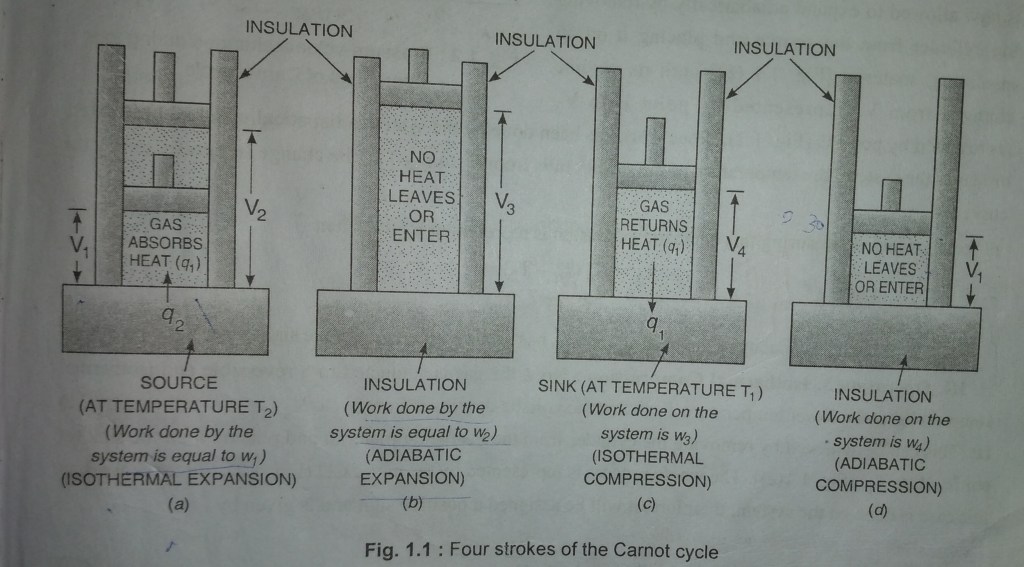
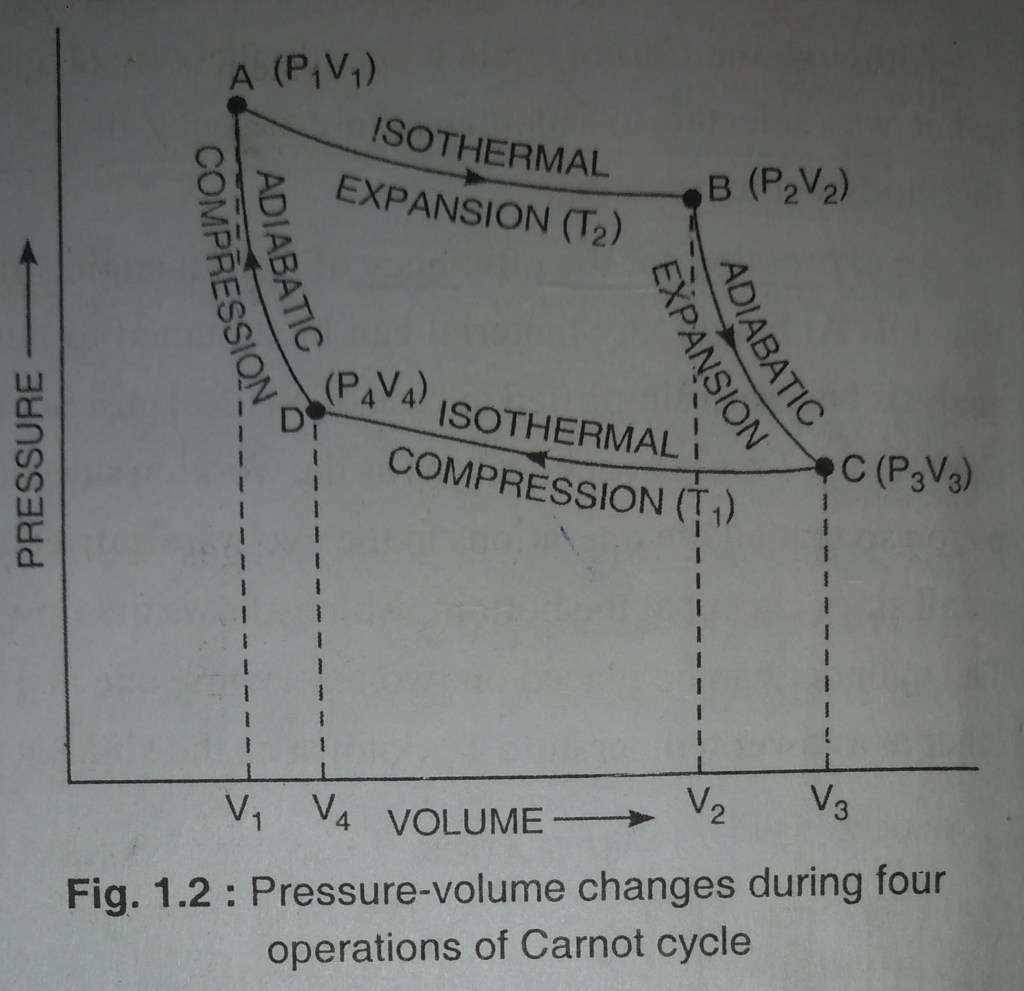
Carnot cycle complete in the following four steps. the value of pressure – volume changes during these steps. as shown in Fig.1.2
Fig. 1.1 : Four strokes of the Carnot cycle.
I. STEP – 1. Isothermal Expansion :
The cylinder containing one mole of an ideal gas is allowed to expand isothermally and reversibly by placing the cylinder on the source of temperature T₂,[Fig. 1.1 (a)] till its volume increases from V₁ to V₂ represnted by the point A to B Fig. 1.2 . The change in volume is reprsented by curve AB
Since in the isothermal expansion of an ideal gas, ΔE = 0, it follows the first law of thermodynamics ” heat absorbed is equal to the work done by the system on the surroundings. If q₂is the amount of heat absorbed by the system at temperatute T₂, and w₁ is the work done by the system on surroundings, then
q₂ = – w₁ = RT₂ ln V₂/V₁ … (i)
( since q₂ is the amount of heat absorbed by the system and w₁ is the amount of work done by the system on the surroundings .∴ according to the sign conventions, q₂ has been taken positive and w₁ has been negative.)
II. STEP – 2 Adiabatic Expansion :
The gas now allowed to expand adiabatically by removing the cylinder from the source and place it on an insulating material [Fig. 1.1 (b) ] until its volume changes from V₂ to V₃ represented by point B and point C respectively. shown in (Fig. 1.2. Since work has been done by the system adiabatically and no heat enters or leaves the system, then, the temperature of the system falls from T₂ to T₁, this change is represented by the curve BC.
let the work done during this adiabatic expansion is represented by w₂. then
– w₂ = Cᵥ (T₁ – T₂)
= – Cᵥ( T₂-T₁). … (ii)
where, Cᵥ is the heat capacity of the ideal gas, And w₂ is work done by the system hence, taken as negative.
Fig. 1.2 Pressure-volume changes during four steps of carnot cycle.
III. STEP – 3. Isothermal Compression:
Now, in this step, place the cylinder on the sink having temperature T₁. by doing this the ideal gas is compressed reversibly and isothermally at temperature T₁, so the volume of gas is decreased from V₃ to V₄ represented by point C and D repectively.[Fig. 1.1 (c)]. The whole process is represented by the curve CD. ( Fig. 1.2).
in this step, work is done on the system. hence taken as positive and, given by,
w₃ = RT₁ ln V₄ / V₃ … (iii)
q₁ is the amount of heat transfered to the surrounding by the system at temperature T₁, hence taken as negative. then q₁ is equal to the w₃, expression is given by
w₃ = RT₁ ln V₄/V₃ … (iv)
IV. STEP – 4. Adiabatic Compression :
The cylinder is now removed from the sink and placed again on an insulating material [Fig. 1.1 (d)].
Now the gas is compressed adiabatically and reversibly until is attains its original volume V₁1 and temperature T₂. the whole process is represented by the curve DA (Fig. 1.2).
▪️In this step, work is done on the system ∴ work taken as positive and is given by.
w₄= Cᵥ (T₂ – T₁) … (v)
The net work is done by the system in the whole cycle is given by
Cyclic process is a process when a system returning back into its original state after completing a series of changes . then, the system said to be completed a cycle and, the entire process is called cyclic process.
state functions like internal energy ‘U’ depends only upon its state initial final or final state. In a cyclic process, the net change in internal energy is zero , i.e., ΔU = 0
According to the first law of thermodynamics , during any isothermal reversible expansion of an ideal gas,
ΔU = q – w
since, ΔU = 0, ∴q – w = 0 or q = w
i.e., the work done is exactly equal to the heat absorbed by the system.
It is very important to note here that although the heat has completely been converted into work at the same time the process is accompained by an increase in volume of the gas meaning thereby that the system has undergone a change.
if the series of changes in the cycle is conducted by keeping the temperature constant , the cycle is known as isothermal cycle.
On the other hand, if the changes in the cycle are brought about reversibly, the cycle is known as reversible cycle.
It is very important to note here that the concept of reversible cycle process is mainly theoritical and imaginary but is of great importance in deriving certain important relationships in thermodynamics.
It is a well known fact that most of the phyiscal changes and chemical changes are accompained by energy changes. these energy changes may take place in the form of heat, light, work, electical changes, etc. All these forms of energy are convertible into one another and hence are related to each other quantitatively.
“The branch of science which deals with th estudy of different forms of energy and the quantitative relation ship between them is known as thermodynamics.
The name thermodynamics is given by the mechanicals engineers in the beginning whon were intrested in only in the conversion of heat into mechanical work. Thermo means heat and dynamics means motion resulting into mechanical work.
NEED FOR THE LAW AND DIFFERENT STATEMENTS OF THE LAW .
According to the first law of thermodynamics ‘ one form of energy can be converted into another form and the total amount of the energy can be conserved ‘ the 1st law gave us the two important state functions E and H , still have some limitations
Due to this limitations , it becomes very necessory to introduce an another law of thermodynamics to overcome those limitations .
LIMITATIONS OF 1ST LAW OF THERMODYNAMICS:
As discussed earlier the 1st law of thermodynamics tell us about the conservation of the energy during any chemical or physical process. but this law doesn’t tell about the feasiblity of a process, i.e, whether the process under the given conditions is feasible or not.
For example , if we burned a papper of a piece in the presence of oxygen , the reverse can not be happen, from ashes paper can not form.
similarly, a bottle of a perfume is opend in a room, it’s vapour spreads in the whole room but the reverse process, i.e, vapours of perfume can not collect themselves in the bottle.
similarly , a gas can expand into vaccum and the process doesn’t violate first law of thermodynamics but the reverse can not be happened.
you have a question in a mind that why all the process above explained are uni-directional in nature ,i.e, occurs only in one direction from products —–> reactants. and cannot be reversed under the similar set of conditions. answers of such questions could not answered by 1st law of thermodynamics.
The answers of these questions was given by 2nd law of thermodynamics . the law states that ‘all the natural and spontaneous phenomenons/processes are unidirectional and irreversible in nature .
For example , the processes like flow of water from up hill to down hill , flow of haet from hot end to cold end, and diffusion of gas from high pressure to a l ow pressure. etc….. all these processes are unidirectional and thermodynamiocally irreversible in nature.
Here , in the above statement of 2nd law of thermodynamics , a term ‘SPONTANEOUS PROCESS.’ is used.
The term spontaneuos means — themselves, and spontaneous process means that the processes may occur themselves , with out any help of external stimulai.
IMPORTANT POINTS ABOUT SPONTANEOUS ;
(a) The spontaneous processes do not proceed in the reverse direction themselves. For example, water will not go uphill by itself. however the spontaneous processes can be reversed with the help of any external factors
(b) The term ‘spontaneous’ doesn’t give any idea about the rate at which the process occurs.
SECOND LAW OF THERMODYNAMICS.
Now lets consider the conversion of heat into work . According to the 1st law of thermodymaics there is an eqivalence between heat absorbed and the work obtained but the heat absorbed can not be completely converted into work without leaving some changes in the system or surroundings. for example heat produced in a steam engine can not completely converted into mechanical work because a part of heat wasted in overcoming the friction. according to this second law of thermodynamics may be stated as :
it is impossible to convert heat into equivalent amount of work with out leaving some changes on the system or surroumdings .
The second law of thermodynamics can also be stated in a number of other forms which we will discuss at various stages in this article . but there are two more common and important forms of second law of thermodynamics are:
1. heat can not flow from a cold body to a hot body with out use of an extrernal agency and,
2. it is impossible to construct a machine , functioning in cycles, which can convert heat completely into an equuivalent amount of work without producing some changes elsewhere in the system.
thank you dear learners that’s all for today see you in next article
In the next article we will discuss about cyclic processes.








 is given by


 InoOP Chem