1.9 ENTROPY CHANGE IN A IRREVERSIBLE PROCESS – B.SC 2ND YEAR.

Let us now suppose that the same system undergoes the same change in an irreversible manner at a constant temperature T. Entropy being a state function , the increase in entropy of the system will be the same irrespective of the fact whether the change has occurred reversibly or irreversibly.

Thus, ΔS will remain the same as before and represented by the expression,

ΔSsystem = qrev/T …(i)

However, actual amount of heat absorbed by the system from the surroundings will be less, being equal to qirr

It also follows from here that heat lost by the surroundings will be less than qrev.However, in view of the infinitely large size of the surroundings, the lost heat by the surroundings is supposed to take place reversibly , i.e. , infinitelyslowly . therefore, mathematically the entropy change of the surroundings is given by the expression,

ΔSsurroundings = – qirr/T …(ii)

The total entropy change for the combined system and the surroundings ,is,therefore,given by ,

ΔSsystem + ΔS surroundings = qrev/T – qirr/T

Now, since work done in reversible process is maximum , therefore, we can say that

wrev > wirr(iv)

Also, as internal energy (U) is a state function ,therfore, the value of ΔU remains the same whether the process is caried out in a reversible or an irreversible manner.

As such we can say that,

ΔU= qrevwrev = qirrwirr(v)

From equation (iv) and (v) we can say that

qrev > qirr

or,

qrev/ T > qirr/T

or,

qrev/T – qirr/T > 0 …(vi)

where ‘T‘ is the temperature at which the change takes place.

From equation (iii) and (vi), we can say that,

ΔSsystem + ΔSsurroundings > 0

i.e , Entropy change for the combined system and the surroundings in an irreversible process is greater than zero , In other words , an irreversible process is accompained by a net increase of entropy.

It may, therefore be concluded from above discussion that entropy of the system and its surroundings taken together increase in a thermodynamically irreversiblr process at constant temperature but remains unchanged in a thermodynamically reversible process

Thus, for a thermodynamically reversible process

ΔSsystem + ΔSsurroundings = 0 and,

for an thermodynamically irreversible process

ΔSsystem + ΔSsurroundings > 0

on combining both the results , we can say that

ΔSsystem + ΔSsurroundings ≥  0

where sign ‘equal to‘ refers to a reversible process while the sign ‘greater than‘ refers to an irreversible process

The above generalizations can also be used to distinguish between a thermodynamic reversible and an irreversible process.

Second law of Thermodynamics in term of entropy change – Entropy of the Universe : since all process in nature are occurring spontaneously and are thermodynamically irreversible, it follows, therefore. that entropy of the universe is continously increasuing . This is yet another statement of Second law of Thermodynamics.

Clausius summed up the essentials of first law and second law of thermodynamics as :

The energy of the universe remains constant but entropy of the universe is continously increasing and tends towards a maximum.
1.8 ENTROPY CHANGE IN REVERSIBLE PROCESS – B.SC 2nd year.

Let a system undergoes a change of state reversibly at a constant temperature T. The heat absorbed by the system from the suuroundings may be represented by qrev . The increase in entropy of the system (ΔSsystem) will then be given by

ΔSsystem = qrev/T …(i)

Since the surroundings have lost heat equal to qrev , reversibly at the same temperature T , the entropy change of surroundings ΔSsurroundings will given by

ΔSsurroundings = – qrev/T …(ii)

(since the surroundings have lost heat , therefore ,it is given a negative sign)

Therefore , total change in entropy of the system and its surroundings during reversible process is given by

ΔSsystem + ΔSsurroundings= qrev/T – qrev/T = 0

It may, therefore , be concluded that in a reversible process, the net entropy change of the system and the surroundings is zero .In other words , there is no net entropy change in a reversible process.

1.7 PHYSICAL SIGNIFICANCE OF ENTROPY- ENTROPY AS A MEASURE OF DISORD- B.SC 2ND YEAR

The physical significance of entropy can be well understood by an examinatiion of various processes which take place with an increase of entropy. On studying these processes, it has been founded that those processes which are accompained by anet increase of entropy also show an incresed randomness.

Consider, for example, the melting of a solid which is accompained by a net increase of entropy . In this case , at the same time there is an increase in th erandom ness of the atoms, ions or molecules .This is because, in the solids, the ions, atoms or molecules are supposed to have fixed positions and in the molten state, they become more free to move.

The evaporation of aliquid alsoi involves in entropoy as well as disorder

Similarly all spontaneous process like flow of heat from a hot end to a cold end of a conductor , transference of molecules of a solute from a more concentrated to a less concentrated solution, flow of electricity from a poin tat a higher potential to a point at a lower potential are all accompained by a net increased of entropy as well as an increase of randomness or disorder.it

follows from above examples that an increase in the entropy is also accompained by an increase in the disorder of the system.

Therefore entropoy is regarded as a measure of the disorder of the system.

Analogy from daily life The concept of entropy and randomness can be better understood by considering the following exmples in our daily life.

Consider the working of a college, when the different classes are being held in different rooms . The randomness or disorder is minimum. But when the bells goes, the students change their own classrooms and get mixed up for 2 – 3 minutes. For these 2 3 minutes, the randomness (or disorder) and hence, the entropy of the college increases .After 2 or 3 minutes, when the students again occupying different rooms, the randomness (or disorder ) and hence, the entropy of the college again increases

(ii) Before the start of any match between the two teams th edisorder is m,inimum as both the teams are on their respective sides but as the game starts players start running and get mixed up in such a situation , the randomness and hence, the entropy increases.


1.6 CONCEPTS OF ENTROPY – B.SC 2nd year

As, we have studied in section 1.3 that in case of reversible Carnot cycle working between temperature T2 and T1,

q₂-q₁/q₂ = T₂ – T₁ / T₂   or 1 – q₁/q₂ = 1 – T₁/T₂

q₁/T₁ = q₂/T₂ …(i)

where q₂ is the amount of heat absorbed isothermally and reversibly at temperature T₂ and q₁ is the amount of heat lost isothermally and reversibly at temperature T₁,

The equation(i) in its general form may b erepresented as ;

qrev/T = constant

where qrev is the quantity of heat absorbed or evolvedin aprocess carrried out reversibly at a temperature T.

The quantity qrev / T, as we shall aee represents a definite or a state function, viz., the entroopy change of the system.

If heat absorbed (q₂) is given a ppositiv esign an dheat lost(q₁) i sa given a negative sign , equation (i) becomes

+ q₂/T₂ = – q₁/T₁ or q₁/T₁+ q₂/T₂ = 0

Σ q / T = 0 …(ii)

Thereffore, when isothermal and adiabatic processes in a carnot cycle are carried out reveribly (i.e, infinitesimally slowly), the summation of q/T terms is equal to zero.

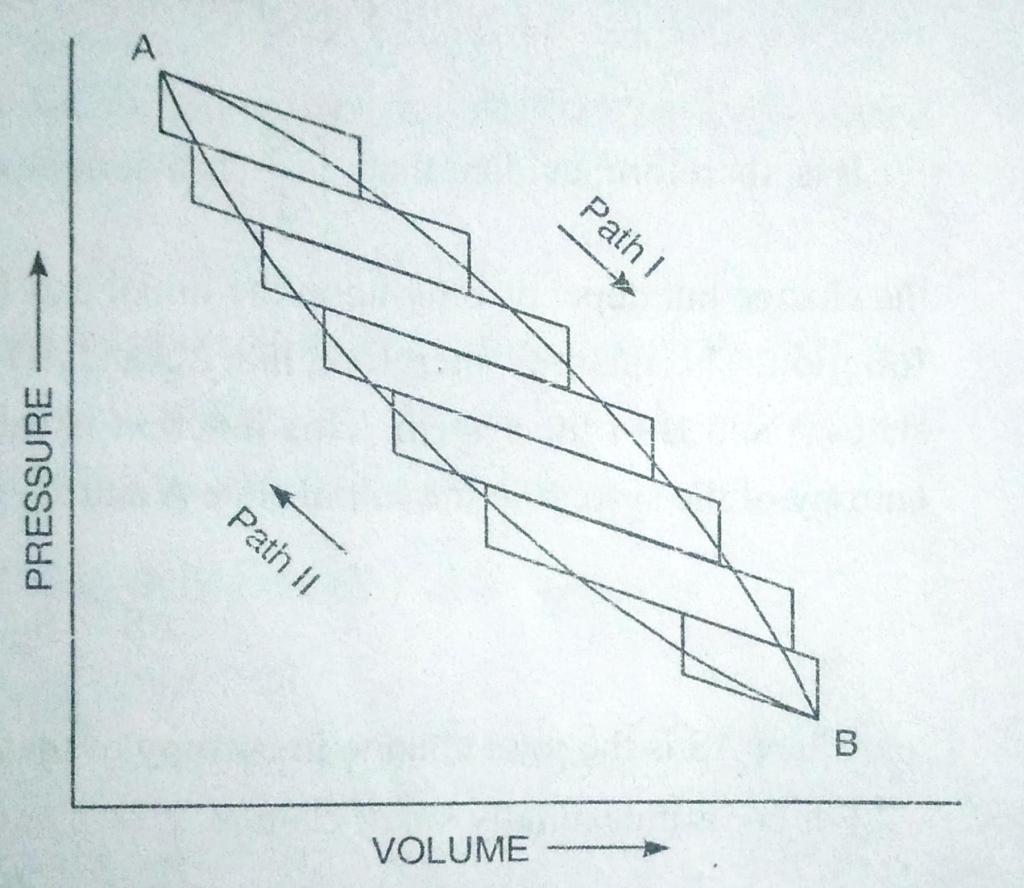
Any reversible cyclic process can be shown to be made up of a series of carnot cycle .let us considered a reversible cyclic process ABA in which the change from A to B and back to stae A ( Fig. 1.3) i scarried out reversibly. Fig 1.3 shows the cycle ABA to be made up of a number of carnot cycles, i.e, of a series of isothermal and adiabatics . The lines slanting horizontally represents adiabatics while those lines slanting vertically represents  isothermals of small carnot cycles . If each Carnot cycle is made extremely small by increasing their number, it can be  made to correspond more closely to continous curve ABA. In such case ,any reversible cycle can be supposed to made up of an infinite number of carnot cycles.

But for each cycle,

q₁/T₁ + q₂/T₂ = 0 …(iii)

Fig.1.3 : Entropy Change in a reversible cyclic process.

Therefore , for the reversible cycle ABA which consist of series of carnot cycles, the above expression can be expressed as,

Σ dq/T = 0

In case,m the changes are infinitesimally small, thenth eabov eequation can be expressede as

Σ dq/T = 0

Since the given cycle is performrd in two steps , viz.,from A to B and back from B bto A, therefore,

  Σ dq/T = AB dq/T  + BA dq/T = 0 . …(iv)

where BA dq/T represents the summation of all the dq/ T terms when the change occurs from A to B via path I and AB dq/T represents the summation of all dq/T terms when the system returns from B to original state A via path II

Evidently from the equation (iv) we have

AB dq/T (path I ) = – BA dq/T (path II)

AB dq/T (path I) = AB dq/T (path II)

It is , therefore, evident that AB dq/T is a definite quantity which does not depend upon the path followed for the change but depends only upon the initial and final states A and B of the system and, is , therefore,  astate function. This quantity, therefore like ΔU and ΔH represemts the change in some singled – valued function of the states A and B of the system. This function is called entropy and is denoted by the symbol S. if SA is the entropy of the system in the initial state A and Sb is the entropy of the system in the final state B, then

ΔS = SB – SA = AB dq/T

where ΔS is the total change in entropy of the system in going from initial state A to the final state B.

for an infinitesimally small change

dS = dq/T

But at  a constant temperature, for a finite change ΔS and Δq can be replaced by ΔS and q respectively . As such, for a finite change at a constant temperrature.

ΔS = q/T

It is important to mention here that since entropy is a function of state only and is independent of path followed, therefore, the change in entropy  in going from initial A to the final state B will invariably be the same whether the change is brought about reversibly or not. but, mathematically, it will be expressed by the expression.

ΔS = AB dq/T

only when the change has been brought about reversibly. this is because the above equation has been derieved from carnot cycle in which all the changes are brought about in a reversible manner.

It is not easy to define the actual entropy of the system. However, it is more convenient to define change of entropy of a system.

The change in entropy of a system may be defined as the integral of all the terms involving heat absorbed (q) divided by the absolute temperature (T) during each infinitesimally small change of the process carried out reversibly.

Thus, for a change at constant temperature,

ΔS = qrev/T

Thus, in simple words, the entropy change may also be defined as the quantity of heat absorbed isothermally and reversibly divided by the absolute temperature (T) at which heat is absorbed.

UNITS OF ENTROPY.

Change in entropy (ΔS) is expressed as

ΔS = qrev/T

Therefore, units of entropy should be expressed as calories per degree i.e., Cal deg-1. This is also called entropy unit.

SI UNITS.

SI units of entropy, accordingly, should be joules per degree kelvin (JK-1)

Since entropy is an extensive property, its value should  depends upon the quantity of the substance involved. Generally, its expressed for one mole of the substance. Hence depending upon the unit of heat, the unit of entropy are either expressed as calories per degree per mole or joules per kelvin per mole.


Rating: 1 out of 5.

Tell us how we are doing by star rating above.

Go back

Your message has been sent

Warning
Warning
Please rate our website(required)

Warning
Warning
Warning!

“I strongly believe that the power of food has a fundamental place in people’s homes that binds us to the best things of life.”

— Lakin Smith

ASSESSMENT – 1.

FOLLOW – UP PROBLEMS

1. Calculate the amount of heat supplied to carnot cycle working between 368K and 268K, if the maximum work obtained is 890 joules.                                   

2. A carnot engin eworking between 373K and 273K takes up 840 joules from the high temperature reservoir. Calculate the work done , the heat rejected and the efficiency of the heat engine.

3. Calculate th efficiency of a steam engine which operates between 373K and 573K. What is the minimum heat which must be withdrawn from the reservoir to obtain 171.52 joule of work ?

4. Two steam engines , one red and one black , take steams at 277ᵒC, while red engine rejects it at 27ᵒC , the  black one reject it at 47ᵒC. compare the efficiencies of the engines.   

5. Calculate the efficiencies of a carnot engine working between 200K and 1000K.                              

6. Heat supplied to a carnot engine is 453.6 kcal. How much useful work can be done by the engine which work between 0ᵒC and 100ᵒC ? 

7. A carnot engine converts one sixth of heat input into work . When the temperature of the sink is lowered to 335K, its efficiency is doubled. Calculate the temperature of source and the sink.                       

8. If the efficiency of a carnot engine is the same (i) between 100 K and 400 K and (ii) between T K and 800 K, calculate the temperature T of the sink.      

9. Calculate the maximum efficiency of a steam engine operating between 110ᵒC and 250ᵒC. What would be the  efficiency of engine if the boiler temperature is raised to 140ᵒC, the temperature of the sink remaining same?

10. What per cent T₁ and T₂ for a heat engine whose efficiency is 10% ?                 

SOLVED PROBLEMS.

Retain in memory.

  • Efficiency of a reversible carnot engine(η) = w/q₂ = q₂-q₁/q₂=T₂-T₁/T₂
  • where,
  • w= Net work done by the system ( Joules /calories) ;
  • q₂= Heat absorbed by the system (Joules / calories) ;
  • q₁= Heat given to the sink (Joules / calories) ;
  • T₂= Temperature o fthe source (Kelvin) ;
  • T₁ = Temperature of the sink (kelvin) ;

EXAMPLE 1. Calculate the efficiency of a reversible carnot engine working between 100K and 500K. calculate the work obtainable in joules if the engine absorbs 1KJ of heat at the higher temperature.

Solution. Given : T₁ = 100K ; T₂ = 500K

Efficiency (η) = T₂-T₁/T₂

= 500-100/500

= 0.80

= 80%

EXAMPLE 2. Calculate the amount of heat supplied to carnot cycle working between 368K and 288K if the maximum work is obtained is 895 joule.

Solution. Given : T₂ = 368K ; T₁ = 288K ; w = 895 joule

now,                          w/q₂ = T₂-T₁/T₂

895/q₂ = 368 – 288 / 368

= 80/368

q₂ = 895 x 368 / 80

= 4117 joules

EXAMPLE 3. What should be the temperature of the sink for efficiency of carnot’s engine to be unity?

Solution.    Efiiciency of the carnot engine (η).

η = T2-T1/T2

since,                               η = 1

1 = T₂-T₁/T₂ 

or, T₂ – T₁ = T₂

or T₁ = 0K

= – 273ᵒ C

EXAMPLE 4. What percent T1 is of T2 for a heat engine whose efficiency is 50%?

Solution.  As we know that,

η= T₂-T₁/T₂

η = 50% = 0.5  (given)

T₂-T₁/T₂ = 0.5

or,

T₂-T₁ = 0.5 T₂

or,

T₁ is 50% of T₂

EXAMPLE 5. An engine operates between 1000K and 500K but passes the waste heat to the secon dengine which is working between 500K and 200K. What is the total efficiency obtained in this case?

Solution. Efficiency of the first engine.

η₁= 1000 – 500 / 1000

= 0.50

= 50 %

i.e. , 50% of heat is rejected to the second engine.

Efficiency of the second engine.

η₂ = 500 – 200 / 500

= 0.60

= 60%

i.e. , 60% of the rejected heat from first engine i.e. , 60% of 50% i.e. ,30% is converted into work .

∴         Total efficiency = 50% + 30% = 80%

LEARNING FACT

“AROUND 1% OF THE SUN’S MASS IS OXYGEN