Let a system undergoes a change of state reversibly at a constant temperature T. The heat absorbed by the system from the suuroundings may be represented by qrev . The increase in entropy of the system (ΔSsystem) will then be given by
ΔSsystem = qrev/T …(i)
Since the surroundings have lost heat equal to qrev , reversibly at the same temperature T , the entropy change of surroundings ΔSsurroundingswill given by
ΔSsurroundings = – qrev/T …(ii)
(since the surroundings have lost heat , therefore ,it is given a negative sign)
Therefore , total change in entropy of the system and its surroundings during reversible process is given by
ΔSsystem + ΔSsurroundings= qrev/T – qrev/T = 0
It may, therefore , be concluded that in a reversible process, the net entropy change of the systemand the surroundings is zero.In other words , there is no net entropy change in a reversible process.
The physical significance of entropy can be well understood by an examinatiion of various processes which take place with an increase of entropy. On studying these processes, it has been founded that those processes which are accompained by anet increase of entropy also show an incresed randomness.
Consider, for example, the melting of a solid which is accompained by a net increase of entropy . In this case , at the same time there is an increase in th erandom ness of the atoms, ions or molecules .This is because, in the solids, the ions, atoms or molecules are supposed to have fixed positions and in the molten state, they become more free to move.
The evaporation of aliquid alsoi involves in entropoy as well as disorder
Similarly all spontaneous process like flow of heat from a hot end to a cold end of a conductor , transference of molecules of a solute from a more concentrated to a less concentrated solution, flow of electricity from a poin tat a higher potential to a point at a lower potential are all accompained by a net increased of entropy as well as an increase of randomness or disorder.it
follows from above examples that an increase in the entropy is also accompained by an increase in the disorder of the system.
Therefore entropoy is regarded as a measure of the disorder of the system.
Analogy from daily life The concept of entropy and randomness can be better understood by considering the following exmples in our daily life.
Consider the working of a college, when the different classes are being held in different rooms . The randomness or disorder is minimum. But when the bells goes, the students change their own classrooms and get mixed up for 2 – 3 minutes. For these 2 3 minutes, the randomness (or disorder) and hence, the entropy of the college increases .After 2 or 3 minutes, when the students again occupying different rooms, the randomness (or disorder ) and hence, the entropy of the college again increases
(ii) Before the start of any match between the two teams th edisorder is m,inimum as both the teams are on their respective sides but as the game starts players start running and get mixed up in such a situation , the randomness and hence, the entropy increases.
As, we have studied in section 1.3 that in case of reversible Carnot cycle working between temperature T2 and T1,
q₂-q₁/q₂ = T₂ – T₁ / T₂ or 1 – q₁/q₂ = 1 – T₁/T₂
q₁/T₁ = q₂/T₂ …(i)
where q₂ is the amount of heat absorbed isothermally and reversibly at temperature T₂ and q₁ is the amount of heat lost isothermally and reversibly at temperature T₁,
The equation(i) in its general form may b erepresented as ;
qrev/T = constant
where qrev is the quantity of heat absorbed or evolvedin aprocess carrried out reversibly at a temperature T.
The quantity qrev / T, as we shall aee represents a definite or a state function, viz., the entroopy change of the system.
If heat absorbed (q₂) is given a ppositiv esign an dheat lost(q₁) i sa given a negative sign , equation (i) becomes
+ q₂/T₂ = – q₁/T₁ or q₁/T₁+ q₂/T₂ = 0
Σ q / T = 0 …(ii)
Thereffore, when isothermal and adiabatic processes in a carnot cycle are carried out reveribly (i.e, infinitesimally slowly), the summation of q/T terms is equal to zero.
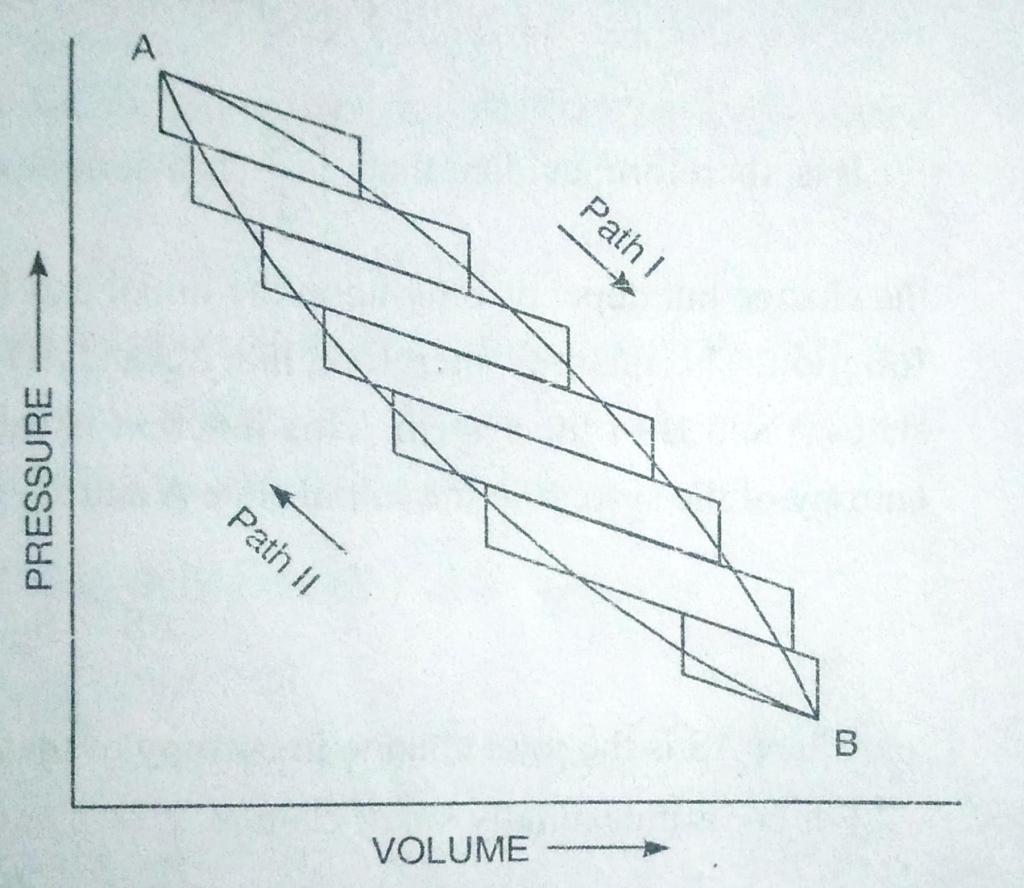
Any reversible cyclic process can be shown to be made up of a series of carnot cycle .let us considered a reversible cyclic process ABA in which the change from A to B and back to stae A ( Fig. 1.3) i scarried out reversibly. Fig 1.3 shows the cycle ABA to be made up of a number of carnot cycles, i.e, of a series of isothermal and adiabatics . The lines slanting horizontally represents adiabatics while those lines slanting vertically represents isothermals of small carnot cycles . If each Carnot cycle is made extremely small by increasing their number, it can be made to correspond more closely to continous curve ABA. In such case ,any reversible cycle can be supposed to made up of an infinite number of carnot cycles.
But for each cycle,
q₁/T₁ + q₂/T₂ = 0 …(iii)
Fig.1.3 : Entropy Change in a reversible cyclic process.
Therefore , for the reversible cycle ABA which consist of series of carnot cycles, the above expression can be expressed as,
Σ dq/T = 0
In case,m the changes are infinitesimally small, thenth eabov eequation can be expressede as
Σ dq/T = 0
Since the given cycle is performrd in two steps , viz.,from A to B and back from B bto A, therefore,
Σ dq/T = A∫Bdq/T + B∫Adq/T = 0 . …(iv)
where B∫Adq/T represents the summation of all the dq/ T terms when the change occurs from A to B via path I and A∫Bdq/T represents the summation of all dq/T terms when the system returns from B to original state A via path II
Evidently from the equation (iv) we have
A∫Bdq/T (path I ) = – B∫Adq/T (path II)
A∫Bdq/T (path I) = A∫Bdq/T (path II)
It is , therefore, evident that A∫Bdq/T is a definite quantity which does not depend upon the path followed for the change but depends only upon the initial and final states A and B of the system and, is , therefore, astate function. This quantity, therefore like ΔU and ΔH represemts the change in some singled – valued function of the states A and B of the system. This function is called entropy and is denoted by the symbol S. if SA is the entropy of the system in the initial state A and Sb is the entropy of the system in the final state B, then
ΔS = SB – SA = A∫Bdq/T
where ΔS is the total change in entropy of the system in going from initial state A to the final state B.
for an infinitesimally small change
dS = dq/T
But at a constant temperature, for a finite change ΔS and Δq can be replaced by ΔS and q respectively . As such, for a finite change at a constant temperrature.
ΔS = q/T
It is important to mention here that since entropy is a function of state only and is independent of path followed, therefore, the change in entropy in going from initial A to the final state B will invariably be the same whether the change is brought about reversibly or not. but, mathematically, it will be expressed by the expression.
ΔS = A∫Bdq/T
only when the change has been brought about reversibly. this is because the above equation has been derieved from carnot cycle in which all the changes are brought about in a reversible manner.
It is not easy to define the actual entropy of the system. However, it is more convenient to define change of entropy of a system.
The change in entropyof a system may be defined as the integral of all the terms involving heat absorbed (q) divided by the absolute temperature (T) during each infinitesimally small change of the process carried out reversibly.
Thus, for a change at constant temperature,
ΔS = qrev/T
Thus, in simple words, the entropy change may also be defined as the quantity of heat absorbed isothermally and reversibly divided by the absolute temperature (T) at which heat is absorbed.
UNITS OF ENTROPY.
Change in entropy (ΔS) is expressed as
ΔS = qrev/T
Therefore, units of entropy should be expressed as calories per degree i.e., Cal deg-1. This is also called entropy unit.
SI UNITS.
SI units of entropy, accordingly, should be joules per degree kelvin (JK-1)
Since entropy is an extensive property, its value should depends upon the quantity of the substance involved. Generally, its expressed for one mole of the substance. Hence depending upon the unit of heat, the unit of entropy are either expressed as calories per degree per mole or joules per kelvin per mole.
As we know the scale of an thermometer is depends on the physical properties like “Thermal expansion” of the liquid used in the thermometer.
Since, different liquids have different cofficient value of expansion, and also do not expand uniformly over a given range of temperature, therefore thermometers are constructed by using different liquids will show different numerical values on thermometer
THE TEMPERATURE AT WHICH AN IDEAL GAS CEASES TO EXSIST IS TAKEN AS ZERO DEGREE ABSOLUTE (-273.15ᵒC) AND THE SCALE DEVELOPED BY TAKING ZERO DEGREE ABSOLUTE AS THE ZERO IS KNOWN AS THE IDEAL GAS TEMPERATURE SCALE AND IS INDEPENDENT OF THE IDEAL GAS TAKEN.
LORD KELVIN, developed a scale of temperature based upon the SECOND LAW OF THERMODYNAMICS
Based on his temperature scale and efficiency of the reversible heat engine, He named his temperature scale THERMODYNAMIC SCALE OF TEMPERATURE Or KELVIN SCALE OF TEMPERATURE. it is very similar to the ideal gas temperature scale.
All the reversible engines are operating between tempratures T₁ and T₂ having the similar efficiency i.e. , η = f ( T₁ – T₂ )
where f is a universal function independent of the working fluid.
since,
η = q₂–q₁/q₂ = 1 – q₁/q₂ = 1 + q₂/q₁,
therefore, q₂/q₁ must also be a function of temperatures of the two reservoirs. A number of different temperature scale that satisfy this relation can be deviesed ; but by taking temperature as directly proportional to the ideal gas temperature scale.
If q₂ is the heat transfer from the source (heat resevior at higher temperature) and q₁ is the heat transfer to the sink (reservoir at lower temperature) and θ₁ and θ₂ are their temperatures on kelvin scale, then
q₂/q₁ = θ₁/θ₂
in other words , we have defineed the ratio of two temperatures in a way is independent of nature of the thermometric substance.
Taking the reciprocal of equation 1 , we have
q₁/q₂ = θ₁/θ₂ or 1- q₁/q₂ = 1- θ₁/θ₂
q₂–q₁/q₂ = θ₂-θ₁/θ₂
Now, if θ1 = 0 (which corresponds to zero of nwe scale), then
q₂-q₁/q₂= θ₂/θ₂= 1
In other words, this means that zero on the kelvin scale is the temperature of the sink for a reversible engine whose efficiency is unity but according to equatiion (15) section 1.3,
Efficiency(η) = q₂-q₁/q₂ = T₂ – T₁/T₂
it is possible only at absolute zero on the ideal gas scale of temperature. from this, it can be concluded that kelvin scale and gas scale are identical; provided the gas is supposed to be ideal, The temperature on the thermodynamic scale is , therefore expressed in kelvin (K).
Learning fact
The only two non-silvery metals are gold and copper. …
Efficiency of a reversible carnot engine(η) = w/q₂ = q₂-q₁/q₂=T₂-T₁/T₂
where,
w= Net work done by the system ( Joules /calories) ;
q₂= Heat absorbed by the system (Joules / calories) ;
q₁= Heat given to the sink (Joules / calories) ;
T₂= Temperature o fthe source (Kelvin) ;
T₁ = Temperature of the sink (kelvin) ;
EXAMPLE 1. Calculate the efficiency of a reversible carnot engine working between 100K and 500K. calculate the work obtainable in joules if the engine absorbs 1KJ of heat at the higher temperature.
Solution. Given : T₁ = 100K ; T₂ = 500K
Efficiency (η) = T₂-T₁/T₂
= 500-100/500
= 0.80
= 80%
EXAMPLE 2. Calculate the amount of heat supplied to carnot cycle working between 368K and 288K if the maximum work is obtained is 895 joule.
Solution. Given : T₂ = 368K ; T₁ = 288K ; w = 895 joule
now, w/q₂ = T₂-T₁/T₂
895/q₂ = 368 – 288 / 368
= 80/368
q₂ = 895 x 368 / 80
= 4117 joules
EXAMPLE 3. What should be the temperature of the sink for efficiency of carnot’s engine to be unity?
Solution. Efiiciency of the carnot engine (η).
η = T2-T1/T2
since, η = 1
1 = T₂-T₁/T₂
or, T₂ – T₁ = T₂
or T₁ = 0K
= – 273ᵒ C
EXAMPLE 4. What percent T1 is of T2 for a heat engine whose efficiency is 50%?
Solution. As we know that,
η= T₂-T₁/T₂
η = 50% = 0.5 (given)
T₂-T₁/T₂ = 0.5
or,
T₂-T₁ = 0.5 T₂
or,
T₁ is 50% of T₂
EXAMPLE 5. An engine operates between 1000K and 500K but passes the waste heat to the secon dengine which is working between 500K and 200K. What is the total efficiency obtained in this case?
Solution. Efficiency of the first engine.
η₁= 1000 – 500 / 1000
= 0.50
= 50 %
i.e. , 50% of heat is rejected to the second engine.
Efficiency of the second engine.
η₂ = 500 – 200 / 500
= 0.60
= 60%
i.e. , 60% of the rejected heat from first engine i.e. , 60% of 50% i.e. ,30% is converted into work .
S.Carnot a french engineer working in french army. In 1824, he observed that the maximum transformation of heat into work can be possible if all the intermidiate steps in the cyclic processses are carried out reversibly. such reversible cycle is called a CARNOT CYCLE. and the engines operating on the basis of carnot cycle called CARNOT ENGINE.
▪️Although the concept of carnot cycle is totally imaginary and theoretical and cannot be achieved in actual practice, but still the concept of carnot cycle is helpful in the calculation of efficiency of the heat engine.
▪️For understanding the concept of Carnot cycle, i’m showing you an expression for the efficiency of a Carnot engine, using a very systematic arrangement.
▪️let us take a cylinder of any material as the working material and an ideal gas, i.e. , for making the analysis easier and simplified. So for the deriving of efficiency of a carnot engine.
▪️Carnot took one mole of an ideal gas as the working substance in a cylinder fitted with a weightless and frictionless piston so that all the process can be carried out reversibly. and, The cylinder is supposed to be insulated from all the sides except from the bottom, which allows the flow of heat to or from the system through the bottom only. The cylinder can be placed on two reservoirs, one at a higher temperature T₂, called SOURCE, and the other at lower temperature T₁, called SINK.
▪️If the process is carried out by placing the cylinder on the source or sink, it can continously exchange the heat with surroundings resulting in the decreasing or increasing the temperature, so that the temperature remains constant. such processes are called ISOTHERMAL – PROCESSES. while ,
▪️If the process is carried out by placing the cylinder on an isulating material, then, no exchnage of heat take place with surroundings, such processes are called ADIABATIC PROCESSES.
STEPS INCLUDING CARNOT CYCLE.
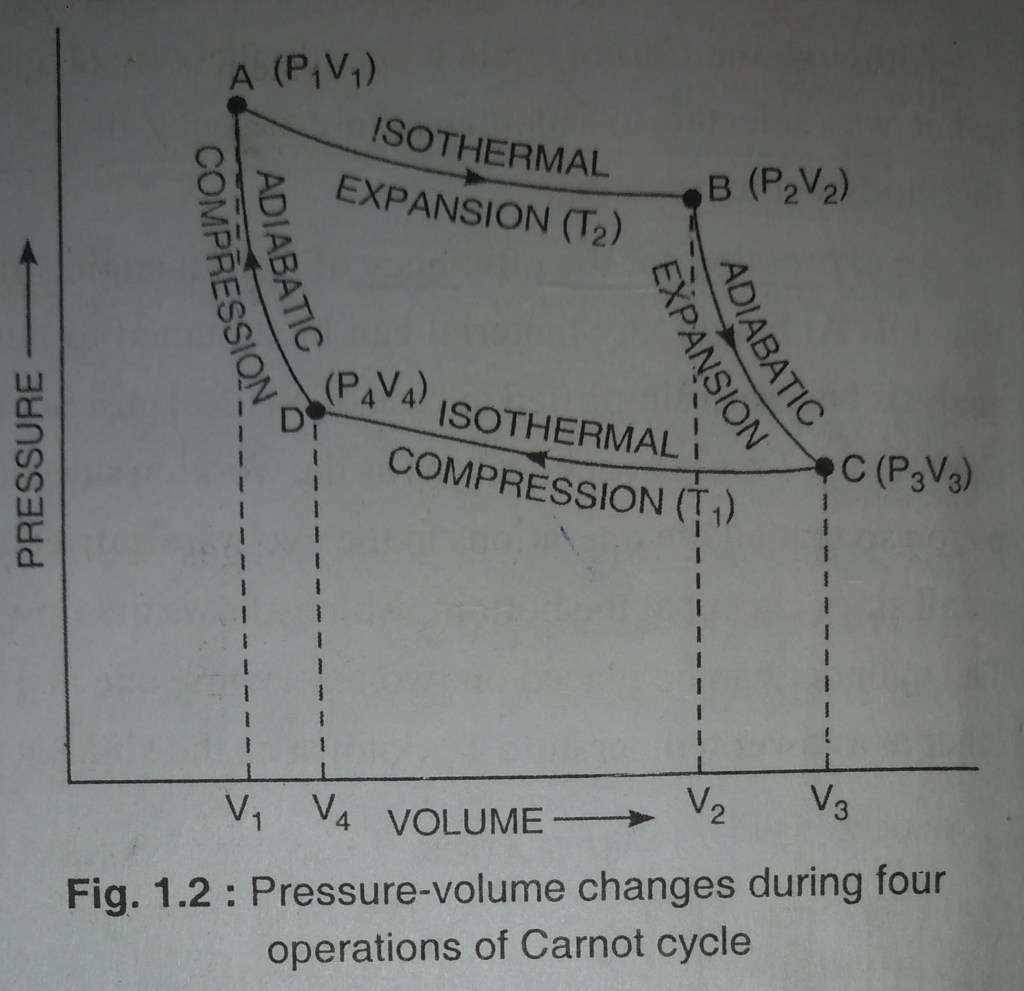
Carnot cycle complete in the following four steps. the value of pressure – volume changes during these steps. as shown in Fig.1.2
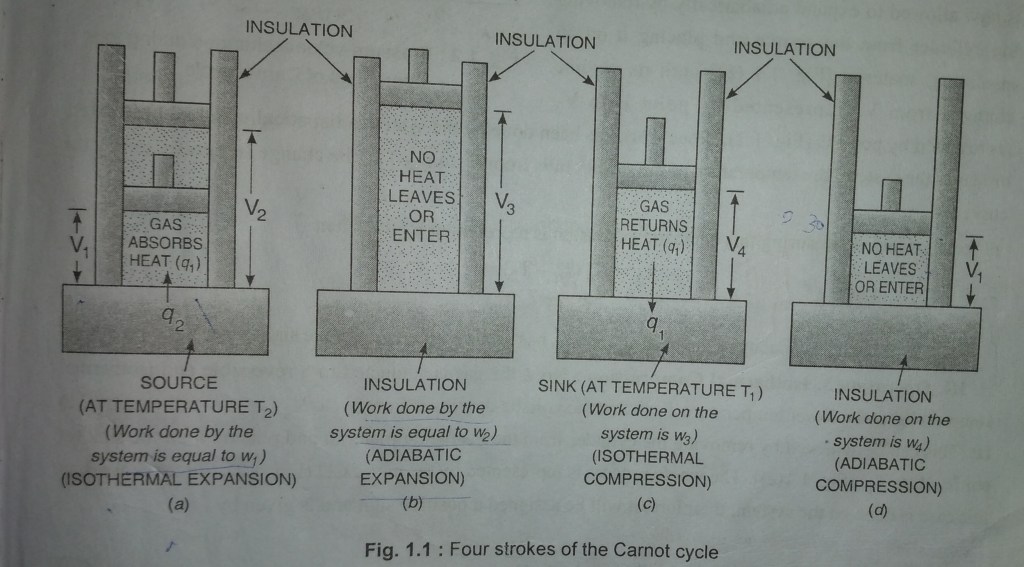
Fig. 1.1 : Four strokes of the Carnot cycle.
I. STEP – 1. Isothermal Expansion :
The cylinder containing one mole of an ideal gas is allowed to expand isothermally and reversibly by placing the cylinder on the source of temperature T₂,[Fig. 1.1 (a)] till its volume increases from V₁ to V₂ represnted by the point A to B Fig. 1.2 . The change in volume is reprsented by curve AB
Since in the isothermal expansion of an ideal gas, ΔE = 0, it follows the first law of thermodynamics ” heat absorbed is equal to the work done by the system on the surroundings. If q₂is the amount of heat absorbed by the system at temperatute T₂, and w₁ is the work done by the system on surroundings, then
q₂ = – w₁ = RT₂ ln V₂/V₁ … (i)
( since q₂ is the amount of heat absorbed by the system and w₁ is the amount of work done by the system on the surroundings .∴ according to the sign conventions, q₂ has been taken positive and w₁ has been negative.)
II. STEP – 2 Adiabatic Expansion :
The gas now allowed to expand adiabatically by removing the cylinder from the source and place it on an insulating material [Fig. 1.1 (b) ] until its volume changes from V₂ to V₃ represented by point B and point C respectively. shown in (Fig. 1.2. Since work has been done by the system adiabatically and no heat enters or leaves the system, then, the temperature of the system falls from T₂ to T₁, this change is represented by the curve BC.
let the work done during this adiabatic expansion is represented by w₂. then
– w₂ = Cᵥ (T₁ – T₂)
= – Cᵥ( T₂-T₁). … (ii)
where, Cᵥ is the heat capacity of the ideal gas, And w₂ is work done by the system hence, taken as negative.
Fig. 1.2 Pressure-volume changes during four steps of carnot cycle.
III. STEP – 3. Isothermal Compression:
Now, in this step, place the cylinder on the sink having temperature T₁. by doing this the ideal gas is compressed reversibly and isothermally at temperature T₁, so the volume of gas is decreased from V₃ to V₄ represented by point C and D repectively.[Fig. 1.1 (c)]. The whole process is represented by the curve CD. ( Fig. 1.2).
in this step, work is done on the system. hence taken as positive and, given by,
w₃ = RT₁ ln V₄ / V₃ … (iii)
q₁ is the amount of heat transfered to the surrounding by the system at temperature T₁, hence taken as negative. then q₁ is equal to the w₃, expression is given by
w₃ = RT₁ ln V₄/V₃ … (iv)
IV. STEP – 4. Adiabatic Compression :
The cylinder is now removed from the sink and placed again on an insulating material [Fig. 1.1 (d)].
Now the gas is compressed adiabatically and reversibly until is attains its original volume V₁1 and temperature T₂. the whole process is represented by the curve DA (Fig. 1.2).
▪️In this step, work is done on the system ∴ work taken as positive and is given by.
w₄= Cᵥ (T₂ – T₁) … (v)
The net work is done by the system in the whole cycle is given by
Cyclic process is a process when a system returning back into its original state after completing a series of changes . then, the system said to be completed a cycle and, the entire process is called cyclic process.
state functions like internal energy ‘U’ depends only upon its state initial final or final state. In a cyclic process, the net change in internal energy is zero , i.e., ΔU = 0
According to the first law of thermodynamics , during any isothermal reversible expansion of an ideal gas,
ΔU = q – w
since, ΔU = 0, ∴q – w = 0 or q = w
i.e., the work done is exactly equal to the heat absorbed by the system.
It is very important to note here that although the heat has completely been converted into work at the same time the process is accompained by an increase in volume of the gas meaning thereby that the system has undergone a change.
if the series of changes in the cycle is conducted by keeping the temperature constant , the cycle is known as isothermal cycle.
On the other hand, if the changes in the cycle are brought about reversibly, the cycle is known as reversible cycle.
It is very important to note here that the concept of reversible cycle process is mainly theoritical and imaginary but is of great importance in deriving certain important relationships in thermodynamics.






 is given by
 InoOP Chem